When should I prep my trees for hurricane season?
Late winter or spring is ideal, so the tree has time to seal its cuts before the weather turns. But any time before a storm beats after one. Atlantic hurricane season runs June 1 through November 30 and peaks from mid-August into October, so if you are reading this in August it is still worth doing.
Can pruning really prevent storm damage?
It meaningfully reduces the risk, though nothing makes a tree stormproof. Thinning the canopy lets wind pass through instead of pushing against a solid sail, and removing dead or cracked limbs takes away the pieces most likely to come down on your roof. What it cannot do is fix a tree that is already rotten or badly rooted, which is why the assessment matters more than the pruning.
Which trees are most likely to fail in a coastal Georgia storm?
Tall pines with shallow root plates on saturated sandy soil, water oaks and laurel oaks that rot from the inside while still looking healthy, anything already leaning, and any tree with a split or narrow V-shaped union between two big stems. Trees left standing alone after a lot was cleared are also high risk, because they never grew up wind-hardened.
Should I top my trees before a hurricane?
No. Topping is the single worst thing you can do to a tree. It removes the canopy the tree feeds itself with, and the fast weak regrowth that replaces it is far more likely to snap off in the next storm than the original limbs were. Proper thinning and weight reduction gets you the wind benefit without wrecking the tree.
How much does storm prep cost?
Far less than an emergency removal, which is the whole point of doing it. Cost depends on the size of the tree, how many need work, and access. An assessment is free, and we will tell you plainly if a tree does not actually need anything.
What should I do the day before a storm hits?
Move vehicles out from under trees, clear the yard of anything that can become a projectile, and photograph your trees and property for insurance. Do not start cutting yourself in the run-up to a storm. If you already know a tree is a problem, call before the forecast, not during it, because once the wind starts every crew in the county is booked.
My tree survived the storm but it looks damaged. Now what?
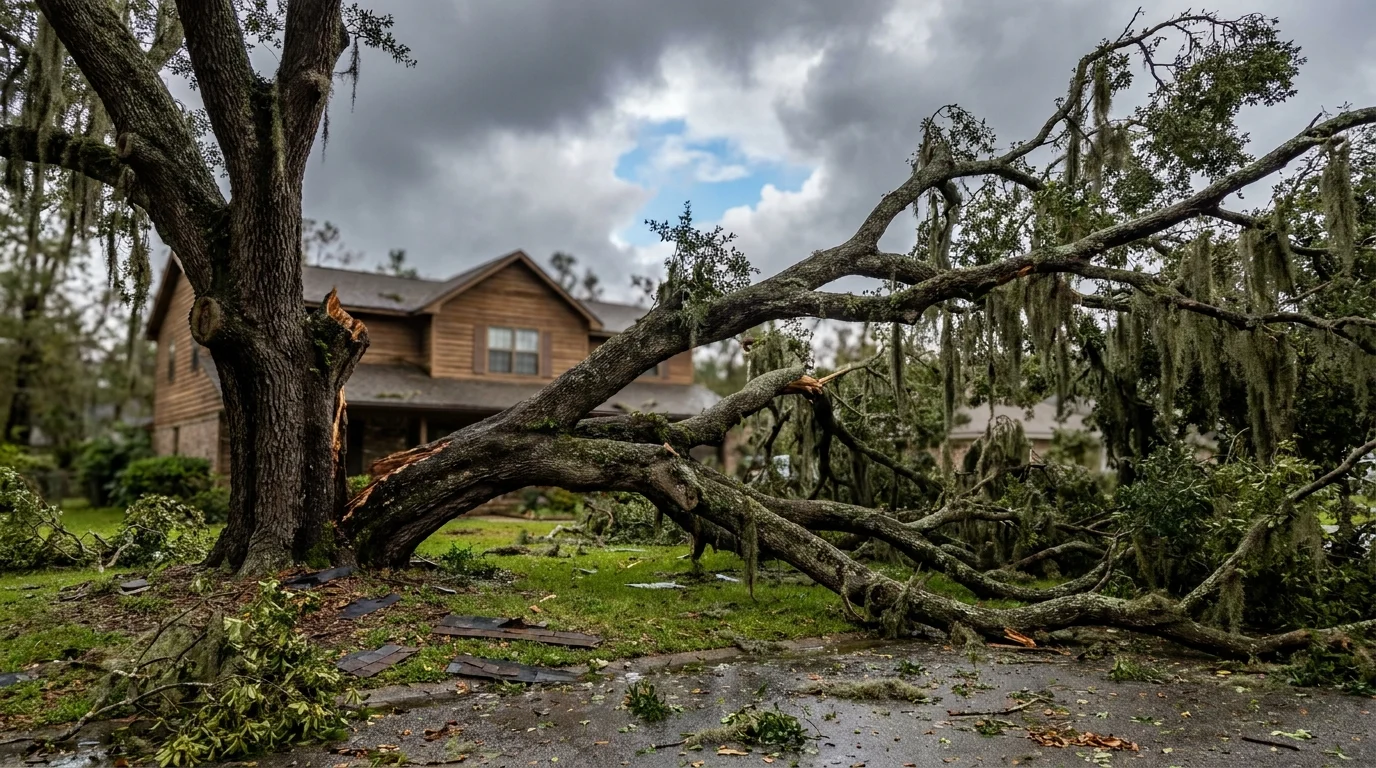
Get it looked at. A tree that has lost a third or more of its canopy, has a fresh lean, has cracked bark down the trunk, or has soil heaved up around the base is often failing even though it is still standing. Some are savable with pruning or cabling. Some are not, and it is cheaper to find out now than after the next storm.
Does homeowners insurance cover tree removal after a storm?
Usually only when the tree hits something covered, like your house, garage or fence. A healthy tree that falls in the open yard is typically your cost, and a tree that was visibly dead or hazardous beforehand can be denied as neglect. That last part is the strongest financial argument for dealing with a known bad tree before the season, not after. Check your own policy.
Do you do storm prep in Effingham County?
Yes. We are based in Guyton and cover Rincon, Springfield, Guyton, Clyo, Eden and Meldrim, plus Richmond Hill and Bryan County, Pooler and the Savannah area. Assessments are free. Call (912) 342-0440.