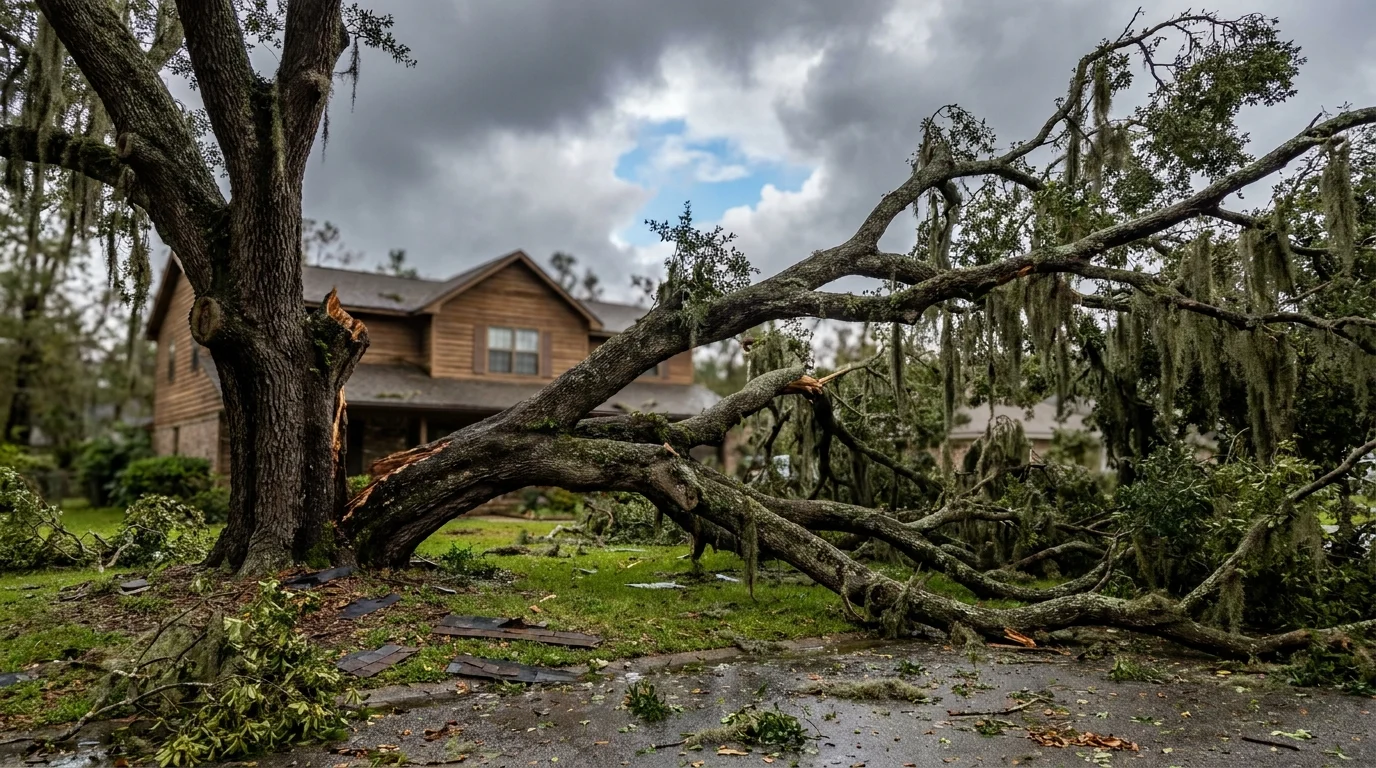
A pine leaning toward your roof can make every thunderstorm feel a little louder. The short answer is that pine trees in storms aren’t automatically unsafe. Their tree health, roots, size, and distance from your house all matter. Wind firmness matters too: a pine with a wide, healthy root plate and good soil depth resists wind loading far better than one growing in shallow, compacted ground, and tall pines standing alone on a lot are the ones we most often discuss lightning protection for. Soil compaction from construction or heavy equipment parked under the tree canopy weakens that root plate over time, which is why we ask about recent work on the lot during a storm-season inspection.
Around Guyton, Rincon, Springfield, Richmond Hill, Pooler, and Savannah, healthy pines are part of Georgia’s “urban forest”, not automatic hazards. We also see trees that looked fine until saturated soil, wind, or hidden decay exposed a problem.
A careful look before storm season can give you a clearer answer than standing at the window and worrying.
Key Takeaways
- Healthy pines with solid roots and sound trunks strengthen the local urban forest.
- A new lean, lifted soil, split trunk, or hanging limb needs attention.
- Sandy soil, clay, drainage, and wind exposure all affect local tree stability.
- Regular inspection and maintenance help protect the urban forest around your home.
- Pruning can help some trees, but it can’t fix serious root or trunk failure.
- Never approach a damaged tree near a power line or try storm work yourself.
Are Pine Trees in Storms Safe Around Georgia Homes?
No tree comes with a promise that it will stay standing in severe weather. In an urban forest, even healthy pines face changing wind, soil, and exposure conditions.
Still, many well-rooted, healthy pines do fine through typical summer rain and wind. The urban forest around a home can also include streets, nearby trees, and other targets that affect the risk.
The concern changes when a tree overhangs a roof, driveway, fence, play area, or power line. A tree’s place in an urban forest matters because it may have nowhere safe to fall.
That does not mean every close tree needs to come down. When we assess pine trees in storms, we consider the entire urban forest around the tree, including the trunk, canopy, root area, soil, past damage, nearby structures, and movement direction. Native species characteristics matter, but they don’t determine the outcome alone.
Warning signs of storm damage and failure
Check from a safe distance. A fresh lean or lifted soil can signal reduced tree stability and possible root failure. Exposed roots, a split trunk, a deep cavity, loose bark, or fungus near the base may indicate internal decay and potential stem failure.
Codominant stems can create weak unions, especially when included bark or cracks are present. Dead limbs, hanging limbs, and repeated branch loss may indicate branch failure.
These signs become more urgent after heavy rain, when the ground is soft, or when high winds are expected. Wind exposure can increase wind loading on already weakened parts of the tree.
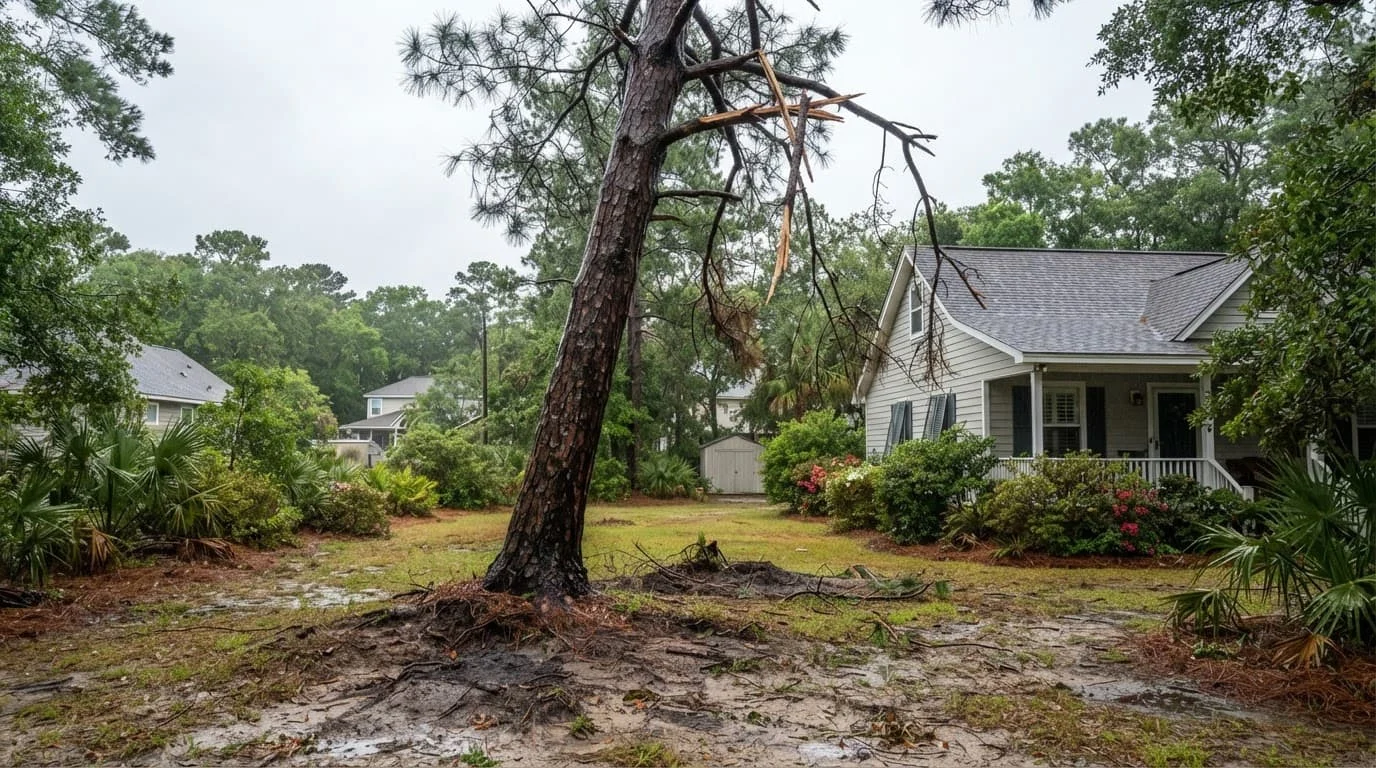
Don’t walk under a damaged tree during a storm. Don’t touch a limb or tree that is close to a power line. Keep people, pets, and vehicles back until the area is safe.
Why a healthy-looking pine can still be a storm concern
Wind loading on the upper tree canopy can act like a sail. A tall pine with a broad canopy may experience greater force than its appearance suggests.
Soaked soil, limited root space, or past root cutting can reduce wind resistance. Greater exposure can also increase wind loading, especially beside open lots, roads, or cleared areas.
Decay inside a trunk can stay hidden from ground level. Grade changes, trenching, driveway work, and soil compaction may hurt roots long before the tree shows obvious tree decline.
A green canopy is a good sign, but it is not a full safety inspection when a tall tree stands close to a home.
A certified arborist can assess the tree, its surroundings, and possible maintenance options. Structural pruning may help address specific defects, but it isn’t a guarantee of safety. An on-site assessment is the sensible next step when a pine is near a house or has started showing warning signs.
How Georgia’s Soil, Weather, and Tree Mix Change the Risk
Effingham County yards are not all alike, and the local urban forest reflects those differences. One property may have loose sandy soil. Another may hold water in clay after a hard rain. Older lots in Savannah, Pooler, and Richmond Hill may have large mature trees that predate the home or driveway.
Within this urban forest, sandy soil can drain fast, but roots may lose their grip when the ground becomes saturated. Clay can hold water longer and shift as it dries. Soil depth, disturbed soil, and limited root space can reduce available rooting volume and support. Poor drainage and root damage can also increase storm damage.
The coastal urban forest also faces summer thunderstorms, strong straight-line winds, and hurricane season from June through November. Tall, exposed trees often have less wind resistance than trees protected by surrounding growth. Saturated ground, hurricane winds, and prior injuries can increase storm damage. The National Weather Service hurricane safety guidance lists the season as June 1 through November 30, which is a good reminder not to wait until a storm is named.
Pines, live oaks, and water oaks need different assessments
Within this urban forest, loblolly, slash pine, and longleaf pine can respond differently to high winds. These tree species may snap or uproot when tall and exposed. Exposed pines face added wind loading, while dead branches can drop without the whole tree failing. Native species may be locally adapted, but height and exposure still matter.
A large live oak brings a different concern, with a broad tree canopy and heavy limbs extending over roofs, driveways, and fences. Water oaks and a laurel oak can create heavy wind loading, especially with weak unions. Another laurel oak may have codominant stems, while a mature laurel oak can show tree decline from chronic site stress. Species-specific structural pruning should preserve sound structure. Other native species also need assessments based on their site and growth patterns.
We don’t label every pine or oak unsafe. We look at the trunk, roots, old wounds, past pruning, surrounding targets, and the tree’s history.
HOA and county questions before storm work
Newer subdivisions may have HOA rules about tree removal or visible changes to a yard. These rules can affect how the urban forest is managed. Some areas may also require approval for protected or unusually large trees.
Rules vary by location and can change. Check current HOA and local requirements before scheduled work, rather than relying on what a neighbor was told years ago. Emergency safety work can be different, but it is still wise to ask when there is time.
Can a Storm-Exposed Pine Be Saved?
Sometimes, yes. A pine may be worth keeping when its trunk is sound, its root system is stable, and the damage is limited to a few limbs or one manageable area. Keeping a sound pine can benefit the property and support the surrounding urban forest.
Corrective tree trimming and pruning can remove broken limbs, reduce a branch over a roof, and clean up damaged growth before it becomes a bigger problem. Structural pruning can address manageable defects and reduce wind loading on a suitable structure.
It isn’t about stripping a tree bare. Removing too much foliage at once can stress the tree, reduce tree survival, and leave it more vulnerable to branch failure.
When pruning or support may be enough
A broken limb with a clean break may be removed without losing the entire tree. A weak branch union, especially where codominant stems join poorly, may be managed with structural pruning.
Cabling and bracing can support certain weak unions when a certified arborist finds them appropriate. These systems may also be considered alongside selective pruning for suitable codominant stems. They can reduce movement in the right situation, but they don’t make a badly failing tree safe or guarantee tree survival through every storm.
Preservation makes sense when the remaining tree has a sound structure and a practical path forward. Keeping it in the managed urban forest can also benefit nearby trees and the property.
When removal is the safer choice
Removal may be the better call when root failure or stem failure creates an active hazard. Internal decay can make a tree unsafe even when its green canopy still looks healthy. The same applies to a split trunk, extensive damage, or a tree that threatens a home, driveway, or access route. A failing pine, oak, or laurel oak may not be manageable through pruning alone.
Thoughtful removal can protect the surrounding urban forest when a hazard cannot be controlled. An in-person review should come before deciding on tree removal. We’d rather preserve a good tree than take one down without a reason, but removal is the honest answer when the hazard cannot be managed.
Afterward, stump grinding can be added if you want the area easier to mow, replant, or use again.
What to Do Before and During a Georgia Storm
Before hurricane season or a forecasted storm, look over your yard from the ground. Pay attention to trees near your home, parking area, fence, and regular walking paths. This quick check can reveal storm damage and help protect the urban forest around your property.
Move vehicles away from a suspect tree if you can do so safely. Bring in loose outdoor items before hurricane winds arrive, and consider wind loading on exposed limbs and vulnerable trees. Think about how you would safely enter or leave the property if a limb blocks your normal route. These steps also help protect the wider urban forest around your property. The Georgia Hurricane Guide advises reporting visible power-line damage to the electric company.
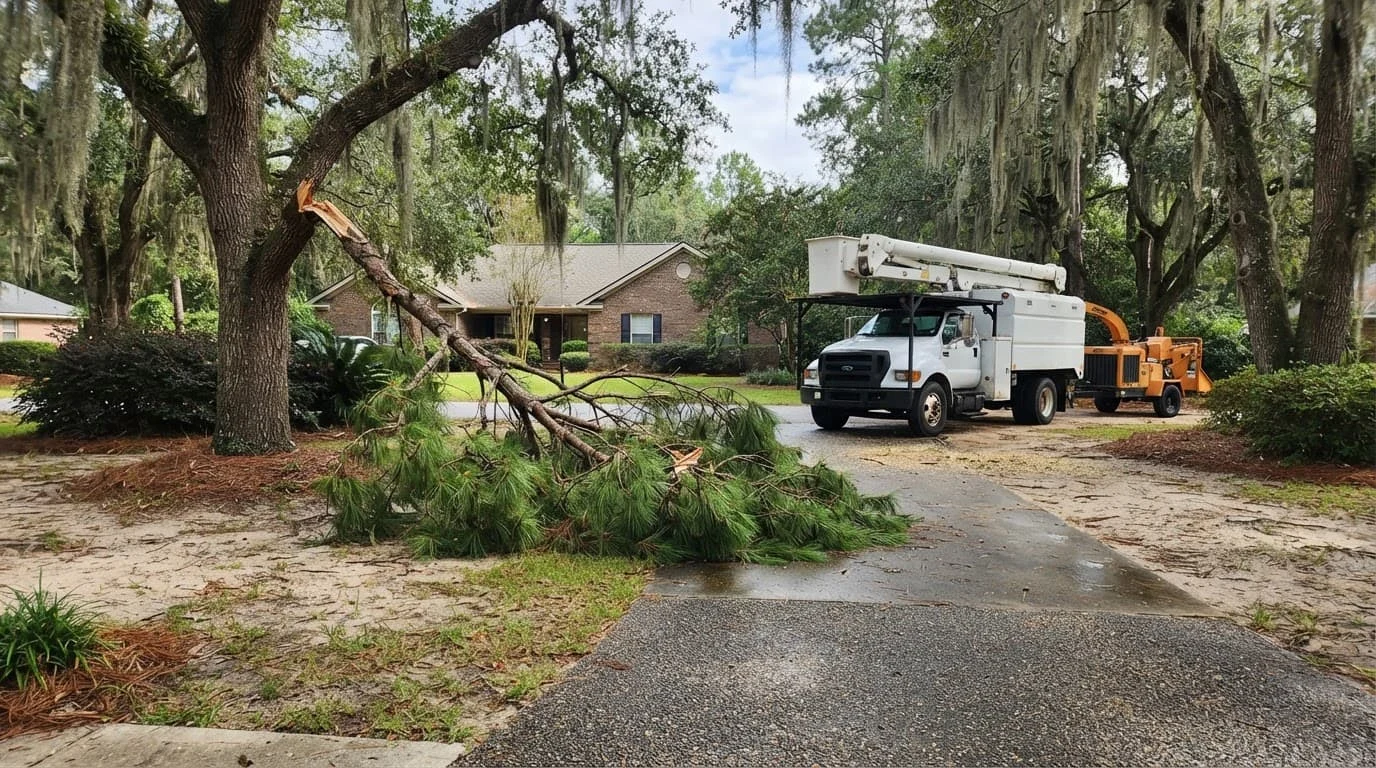
For a fallen tree, hanging limb, or a tree threatening the roof, storm damage and emergency tree service can focus on making the area safer and clearing access.
Why storm tree work is not a DIY job
Storm-damaged wood does not behave like a limb on the ground. A branch can be under tension and spring or roll when cut. A trunk may shift because stem failure or root failure has already begun.
Ladders, chainsaws, wet ground, and power lines add more risk. Structural pruning is planned maintenance, not emergency cutting. Even experienced homeowners should leave elevated or unstable work to a certified arborist or licensed and insured tree service.
If a tree or limb has contacted a power line, call the utility company first. Stay well away and keep children and pets out of the area.
What happens during a professional assessment or cleanup
We review the tree, its surroundings, and how it fits into the urban forest around your property. Then we identify immediate hazards and assess its wind resistance, rather than judging it by obvious damage alone. We talk plainly about whether saving the tree or removing it makes more sense.
Mike Williams brings 20+ years of hands-on tree experience to the work on site. Mary Gledhill handles scheduling, communication, and coordination, so you are not left wondering what happens next.
Our plan accounts for storm damage, the tree’s condition, your home, access, and cleanup. Some jobs call for careful limb removal. Others call for controlled removal because the tree has already crossed the line into a hazard.
When to Call Us for a Free Estimate
Call for an assessment when you see a leaning pine, lifted soil, hanging limbs, repeated branch loss, storm damage, or a tree reaching over your roof or driveway. A certified arborist can also help when you’re unsure whether a damaged tree can be saved.
We work with homeowners and small property owners in Guyton, Rincon, Springfield, Bloomingdale, Effingham County, Richmond Hill, Pooler, Savannah, and nearby communities. We evaluate local trees, including pines and laurel oak, to help keep the urban forest safer around homes. As a family-owned, licensed and insured company, we give straight answers based on what is in front of us.
A photo can help start the conversation, but an on-site review gives a much better answer after storm damage. Root problems, internal decay, and the direction of a lean are hard to judge from across the yard, and a professional review helps maintain a safer urban forest around homes.
If a tree has you concerned before the next storm rolls through, request a free estimate. There is no pressure to remove a tree that can be managed safely.
Frequently Asked Questions
Should a pine tree be removed before every hurricane?
No. Hurricane preparation doesn’t mean cutting down every pine on the property. Each removal decision also affects the residential urban forest.
The choice depends on the tree’s condition, root stability, distance from structures, and wind exposure. A sound tree with room to stand may be fine. A damaged tree over a bedroom or driveway is a different situation.
Is a leaning pine always dangerous?
Not always. Some trees grow with a natural lean and remain stable for years. Keeping healthy trees can also support a stronger urban forest.
A new or worsening lean is more concerning, especially with cracked soil, lifted roots, exposed roots, or recent storm damage. Keep back if the tree looks unstable.
Can a pine recover after losing a large limb?
It depends on where the break happened and how much of the canopy remains. A limited limb break can sometimes be cleaned up and managed.
Major trunk damage, large tears, decay, or root movement can change the answer. The remaining structure has to be safe, not merely alive.
What should happen if a pine falls on a house or driveway?
Move people away from the area and don’t touch the tree. Stay clear of damaged structures and all power lines.
Emergency work should first address safety and access. Electrical hazards and structural damage may also need attention from the utility company or other qualified professionals.
A Clear Answer Starts With the Tree in Front of You
Pine trees are not automatically unsafe in storms. What matters is the tree’s condition, its roots, local soil, recent weather, and what could be damaged if it fails. Species and site conditions matter too, including native species such as laurel oak and the wind loading on a pine’s canopy.
We look for a way to keep a healthy tree when its structure and site give tree survival a reasonable chance. That approach supports the wider urban forest, but we’ll tell you plainly when storm damage risk cannot be managed.
For a property in Effingham County, Richmond Hill, Pooler, Savannah, or the surrounding area, request a free estimate from LoyalTree to protect your place in the local urban forest.