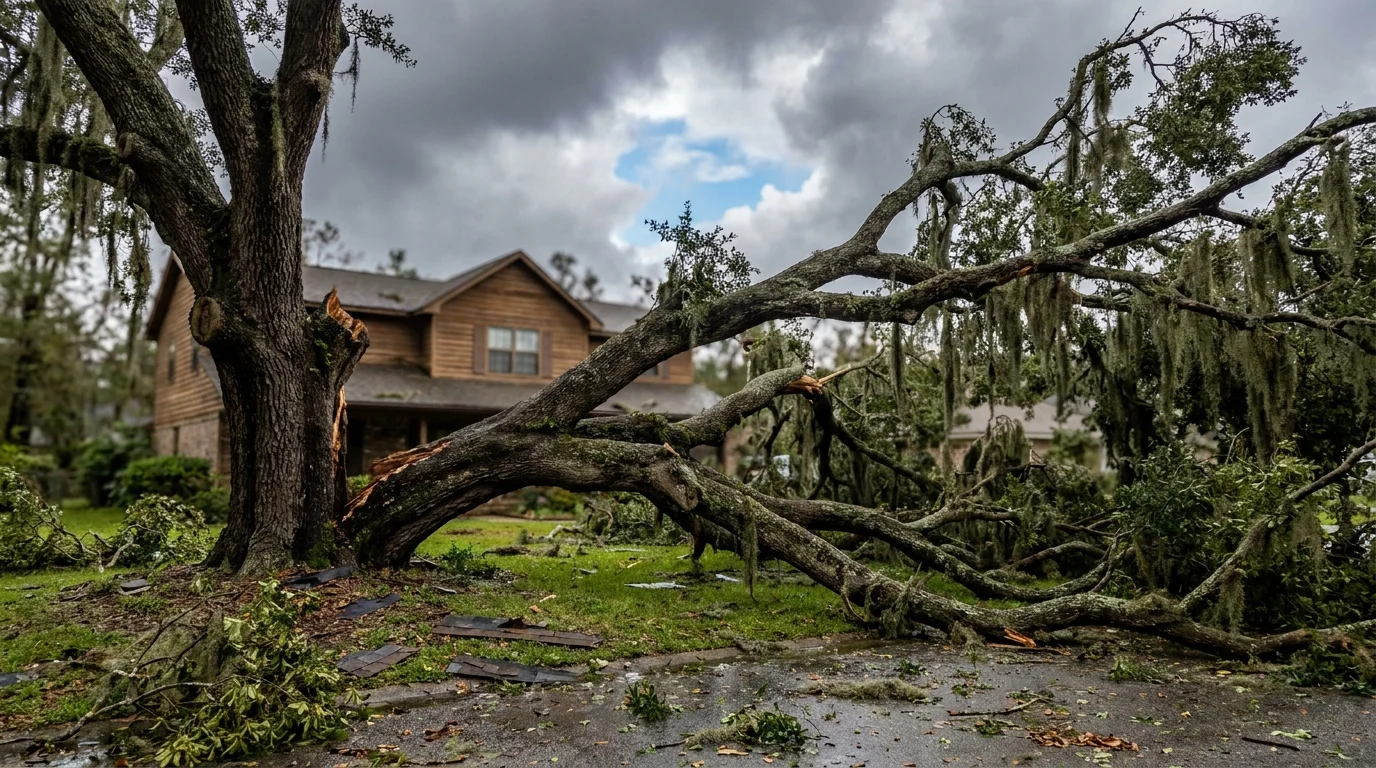
Somebody planted a row of Leyland cypress along the back fence eight or ten years ago, and for a while it was the best thing they ever did to that fence line. Fast, thick, evergreen, and it blocked the new house behind them.
Then one tree went brown in the middle. Then a whole one died. Now there is a gap in the screen you cannot unsee, and everything you read online says something different about why.
We are LoyalTree LLC, family-owned out of Guyton, and Mike Williams has 20+ years of hands-on tree experience. We take out a lot of dead Leylands around Effingham County. Here is what is actually going on with them, and what to do about the row you have.
Key Takeaways
- Leyland cypress is a fast-growing hybrid that extension services across the Southeast now call problematic in our heat and humidity.
- Most sudden browning traces back to canker diseases, root rot in wet soil, or bagworms.
- Planting them too close together is the single biggest cause of the problem, and it is nearly always done.
- Interior browning in fall can be normal shedding. Whole branches or whole trees going brown is not.
- Once a Leyland browns out, that section does not grow back. Replacement is usually the answer.
First: Is It Normal Shedding?
Before the bad news, rule out the harmless version. Evergreens shed. In fall, Leylands and other conifers drop some of their oldest interior foliage, the stuff closest to the trunk and shaded out by newer growth. You get a band of brown deep inside while the outside of the tree stays green.
That is fine, and it happens on the same schedule as pine straw drop.
What is not fine: brown at the tips and the outside of the branches, an entire branch browning from where it meets the trunk outward, a distinct dead patch on one side, or a whole tree fading. Those are the patterns worth diagnosing.
The Real Causes, In the Order We See Them
Canker diseases
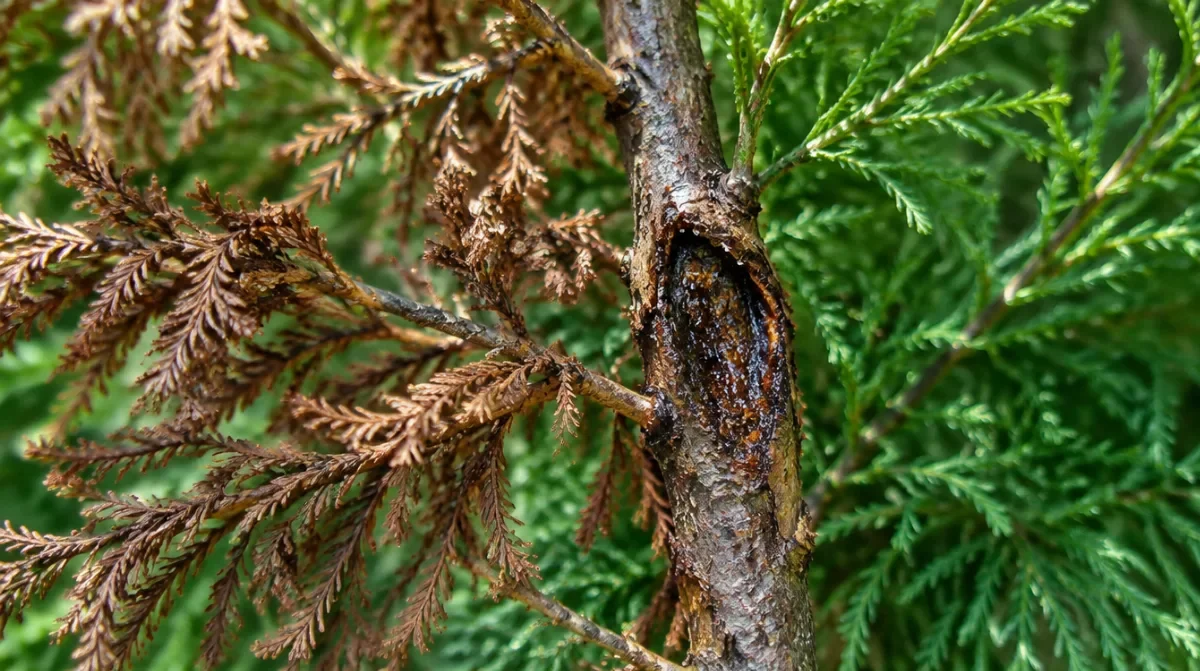
This is the big one. Fungal cankers, seiridium and botryosphaeria being the two names you will run into, infect the stems and girdle them. Everything beyond the infection point dies, which is why you get one whole branch browning while its neighbor stays green.
The tell is on the wood, not the foliage. Follow a brown branch back toward the trunk and look for a sunken, discolored, sometimes cracked area on the stem, often with resin weeping out of it. That is the canker. Seiridium usually weeps resin and botryosphaeria usually does not, so no resin does not rule a canker out.
These fungi are opportunists. They take hold in trees that are already stressed by drought, heat, crowding or poor drainage, which is most Leyland cypress in a Georgia hedge row. There is no spray that cures an established canker. Pruning the infected branch out well below the canker, in dry weather, sanitizing the blade between every cut, slows it down. That is all you get.
Root rot in wet ground
Leylands hate wet feet, and a lot of our coastal soil holds water after a heavy week. Phytophthora root rot shows up as a general fade: the whole tree dulls, then goes yellow-green, then brown, top to bottom rather than branch by branch. Pull on a section of root: if the outer sleeve slips off the inner core easily, that points to root rot. Confirming it takes a root and soil sample through your county extension office.
Once it has the roots, the tree is finished, and replanting another Leyland in the same hole usually repeats the result.
Bagworms
Look closely at a browning Leyland for small spindle-shaped bags, an inch or two long, made of bits of the tree’s own foliage, hanging from the branches. They look like little cones and they are easy to miss. A heavy population will strip a Leyland, and unlike a hardwood, a conifer stripped bare generally does not push new growth to replace it.
Handpicking the bags off in winter and destroying them genuinely works on a small row, because the female bags each hold hundreds of next year’s eggs. Timing of any treatment matters and your UGA county extension office can tell you the right window for our area.
Crowding, which causes all of the above
Here is the underlying mistake. Leyland cypress is sold in a three-gallon pot and planted five or six feet apart because that is what makes a screen fast. The mature tree wants to be sixty to seventy feet tall, sometimes more, and fifteen to twenty feet wide.
So within a decade the row is a single crowded mass. Roots are competing for the same water. Air does not move through, so foliage stays wet after every rain, which is exactly what canker fungi want. The interiors are fully shaded and die out. One tree gets sick and the next one is touching it.
Almost every failing Leyland row we look at was planted too close. It is not the homeowner’s fault; it is how they are sold.
Can You Save a Browned-Out Leyland?
Mostly, no, and this is the part people do not want to hear.
Leyland cypress does not reliably produce new growth from old bare wood. Cut back into the brown interior and it stays brown. A hardwood hedge you can renovate; a Leyland you cannot. That means whatever has died is permanently a hole in your screen.
What is worth doing:
- Remove the dead trees. They will not recover and they are a reservoir for the fungus sitting right against the healthy ones.
- Prune out cankered branches three to four inches below the diseased tissue, in dry weather, sanitizing the blade between cuts with rubbing alcohol or one part bleach to nine parts water. Get the prunings off the property.
- Improve drainage if water stands in that line after rain.
- Water deeply during drought rather than lightly and often. Drought stress is what lets cankers in.
- Mulch properly, a wide ring, not piled against the trunks.
- Do not cut back past the green. A Leyland will take a shearing of its green growth, but anything cut back into bare wood stays bare and the wound is another way in. Same principle as tree topping on a shade tree.
Winter is a good time to do this work. The row is easier to get into, and removals and stump grinding go easier on firm ground. There is more on that in stump grinding versus stump removal.
What to Plant Instead
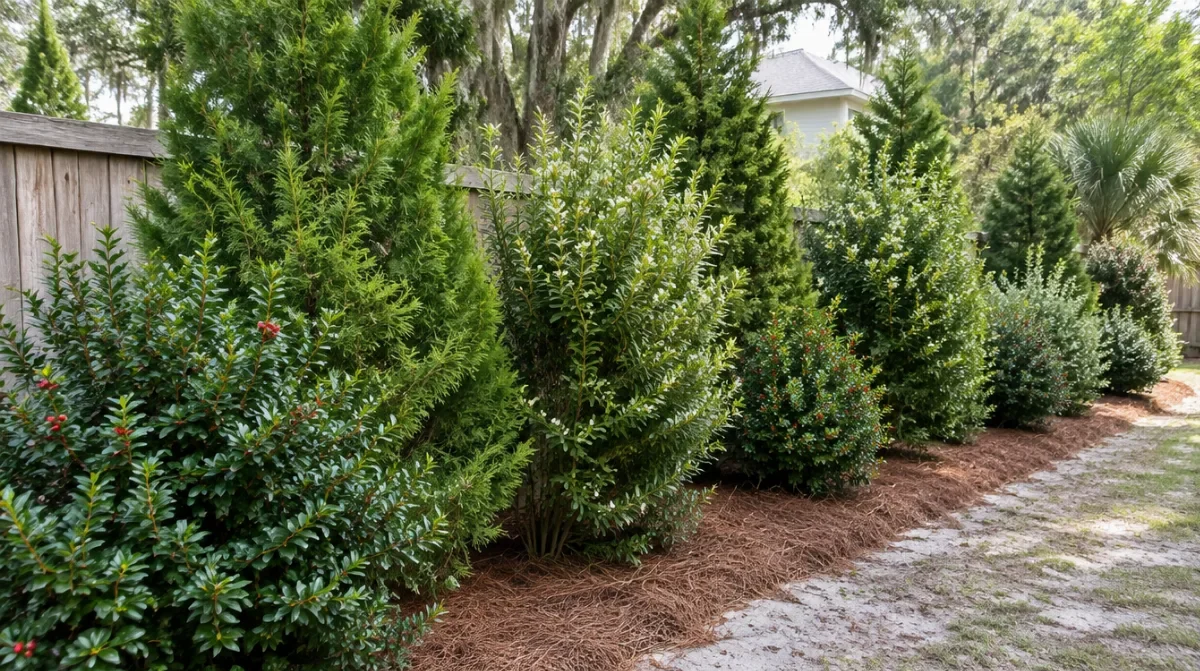
The best fix for a failing Leyland row is a mixed screen. One species planted in a straight line is a monoculture, and monocultures fail all at once. Mix three or four things and one disease cannot take the whole fence line.
Good coastal Georgia choices:
- Eastern red cedar. Native, tough, handles our heat, drought and salt air, and birds love it. Fair warning, bagworms like it too, so keep an eye on it.
- Wax myrtle. Native, fast, takes wet ground and salt, and can be kept as a hedge or let grow.
- American holly, Nellie Stevens or yaupon. Dense evergreen structure with winter berries. Buy female plants, and for American holly and yaupon you need a male nearby to get fruit. Nellie Stevens sets berries on its own.
- Southern magnolia cultivars where you have room for something large.
- Cryptomeria. Similar look to a Leyland, generally more disease-tolerant here.
Stagger them in two offset rows instead of one straight line, and space them for the size they actually reach. A screen that takes four years instead of two and then lasts for decades is the better choice.
Frequently Asked Questions
Why is my Leyland cypress turning brown from the inside?
Interior browning in fall is often normal shedding of old shaded foliage. Browning at the branch tips, a whole branch dying, or a whole tree fading points to canker, root rot or bagworms.
Will a brown Leyland cypress grow back?
No. Leyland cypress does not reliably produce new growth from bare old wood, so browned sections stay bare. That is why replacement is usually the practical answer.
How far apart should Leyland cypress be planted?
Clemson says a minimum of 12 to 15 feet apart for air circulation. They mature at fifteen to twenty feet across, so a screen planted five feet on center is guaranteed to crowd. Honestly, we would suggest planting something else.
Is there a spray for Leyland cypress canker?
No fungicide cures an established canker. Management is cultural: remove infected wood, reduce stress, improve air movement and drainage. Talk to your UGA county extension office before applying anything.
Should I replace just the dead ones in the row?
You can, but a young tree squeezed between two mature crowded ones rarely thrives, and if canker is in the row it is right there waiting. Replanting the whole line with mixed species usually gives a better result than patching.
A Screen That Outlasts the Reason You Planted It
In the rows we take out around Effingham County, a crowded Leyland screen usually gives you about a decade before coastal Georgia catches up with it. That is not bad luck. It is an accidental hybrid of two cool, coastal Pacific species, neither of which came from anywhere like a Georgia summer, planted at spacing that guarantees stress.
If yours is going, winter is the right time to clear it out and put in a mixed screen that will still be standing when the kids are grown.
Want somebody to look at the row and tell you what is salvageable? Request a free estimate or call (912) 342-0440.