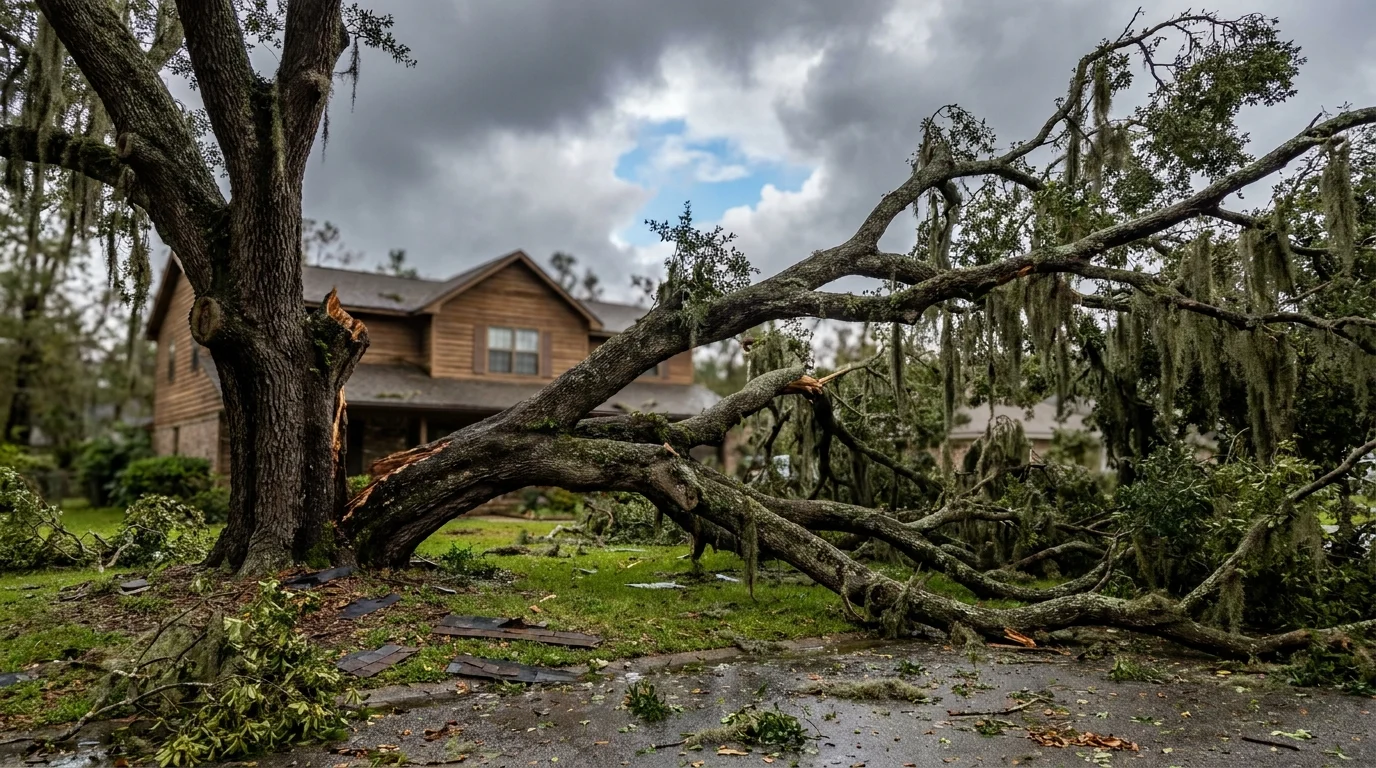
Spanish moss is the thing people move here for and then start worrying about. It is on the postcards, it is on the live oaks along every road in the Lowcountry, and then one November you look up at a tree that has gone bare and thin and you think: that moss is choking it.
We get asked about this constantly, usually in the fall, and usually by somebody who has already been told by a neighbor to get it stripped out. Here is the straight answer, and the part of the worry that does turn out to be worth paying attention to.
We are LoyalTree LLC, family-owned out of Guyton. Mike Williams brings 20+ years of hands-on tree experience to coastal Georgia trees.
Key Takeaways
- Spanish moss is not a parasite. It has no roots in the tree and takes nothing from it.
- It is an air plant in the bromeliad family, a relative of the pineapple, not a moss at all.
- Heavy moss on a thin, declining tree is a symptom, not the cause. More light gets in, so more moss grows.
- Heavy moss can shade a canopy that is already thin, but it does not add enough weight to break a sound limb.
- Removing it is cosmetic. Removing it from a tree that needs pruning anyway makes sense. Stripping a healthy oak does not.
What Spanish Moss Actually Is
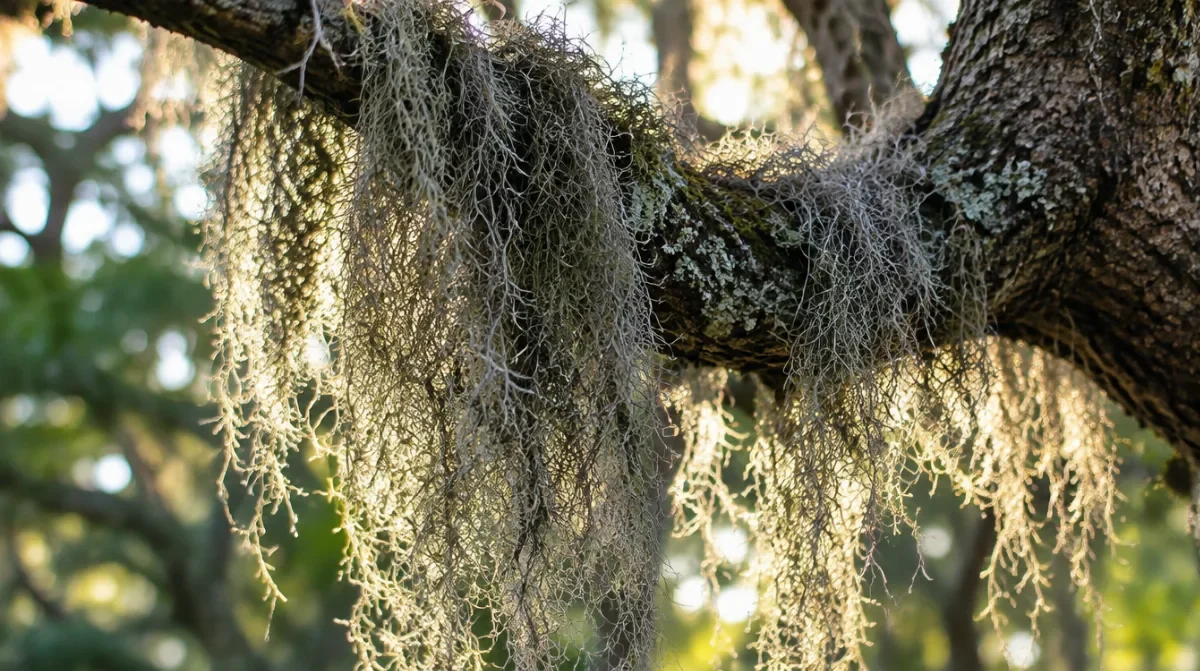
Tillandsia usneoides is a flowering plant in the bromeliad family. Pineapples are cousins. It is not a moss, and despite the name it is not Spanish.
The important part is how it feeds. Spanish moss is an epiphyte, an air plant. It has no roots at all, into the tree or into anything else. It drapes over a limb and holds on physically the way a scarf hangs on a hook. It pulls moisture out of our humid coastal air and nutrients out of rainwater, airborne dust and whatever washes down the bark. The tree is furniture, not food.
That is why you also see it hanging on power lines, fences and porch railings in Savannah, none of which it is feeding on either.
So Why Are the Mossiest Trees the Sickest Looking?
Because you have the arrow pointed the wrong way, and this is the single most useful thing to understand about it.
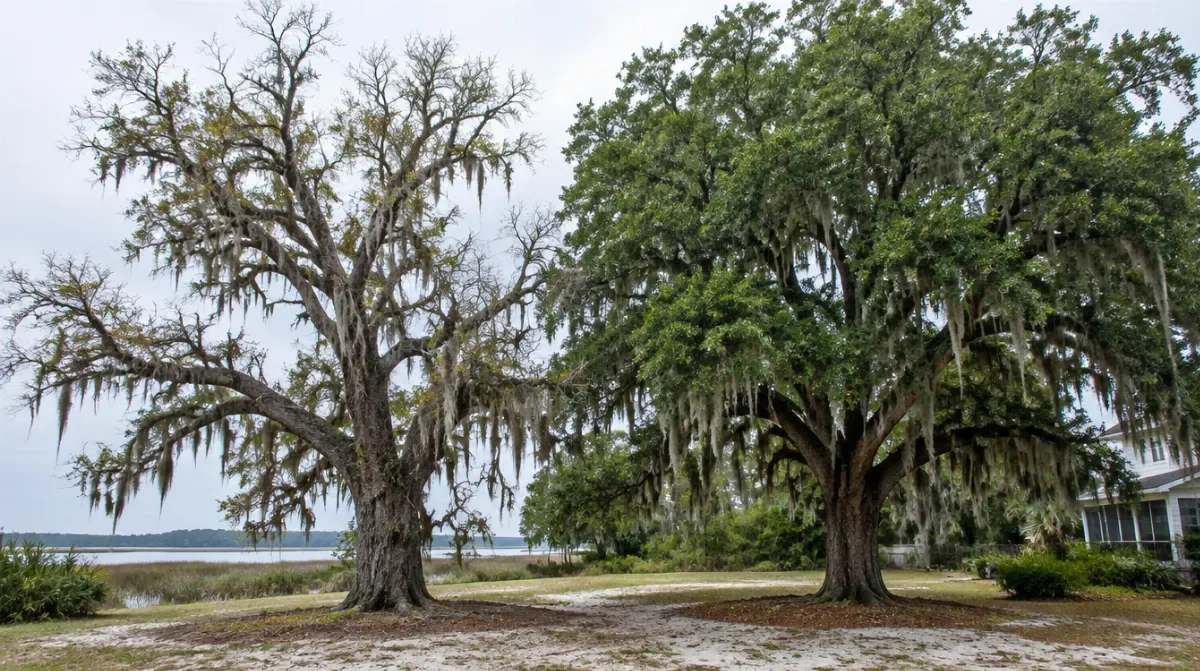
Spanish moss needs light. A vigorous live oak with a dense canopy shades its own interior, and moss does not get established heavily in there. When a tree starts to decline, the canopy thins, foliage drops out, and suddenly sunlight is reaching branches that have been in shade for decades. Moss takes off.
So the tree did not get sick because the moss moved in. The moss moved in because the tree got thin. If you strip the moss and change nothing else, you have removed the symptom and left whatever is actually wrong, which might be root damage, construction compaction, decay in the trunk, or just age. Our guide on how to tell if a tree is dead or just struggling covers what to look for instead.
There is a second version of the same thing: a limb that has already died holds moss beautifully, because nothing is shading it and nothing is shedding it. A branch absolutely buried in moss is often a branch that was dead first.
The Part That Is a Real Concern
There is one way heavy moss actually works against a tree, and it is not the one people expect.
Shading a tree that is already thin
A truly heavy load of moss can shade the tree’s own remaining leaves. On a healthy oak that is no problem, because the canopy is dense enough that the moss never gets established in the interior anyway. On a tree that has already thinned out, it is one more thing working against a tree that is short on energy to begin with. This is the concern UF and Clemson extension actually document, and it is the reason to pay attention to a heavily mossed tree: not the moss itself, but what the moss is telling you about the canopy.
What about the weight in a storm?
This one gets blamed a lot and the research does not back it up. UF extension puts it plainly: limb breakage is often attributed to the weight of the moss, but moss contributes an insignificant amount of weight and is almost never a factor in broken branches. Wet moss is heavier than dry moss, but not by enough to bring down a sound limb. If a mossy limb came down in a storm, look at the union and the wood, because that is where the answer is. Our guide on hurricane season tree preparation covers what we actually check.
Worth adding: the old story about chiggers and redbugs living in Spanish moss up in the trees is mostly not true. Moss that has been lying on the ground is a different matter. Do not stuff a bag of it from the yard into a pillow.
Should You Have It Removed?
Here is how we think about it.
Healthy tree, moderate moss: leave it. It is doing no harm, it is the reason your street looks like it does, and stripping it means putting climbers through the canopy for purely cosmetic reasons.
Healthy tree, very heavy moss: reasonable to thin it if the look bothers you. Usually this happens as part of a pruning visit rather than as its own job.
Declining tree, heavy moss: the moss is the least of it. Get the tree assessed. Pulling moss off a failing oak is rearranging furniture.
Dead limbs full of moss: yes, and what you are really buying is deadwood removal. The moss comes down with the limb.
Practically, removal is hand work from a bucket or on rope. There is no spray we would recommend putting on a live oak to kill moss, and copper-based products sold for that purpose can damage foliage and are easy to overdo. Anybody offering to spray your oaks for moss should be asked a lot of questions.
And never do it yourself from a ladder with a pole. Reaching overhead off a ladder into a live oak is a good way to end up in the emergency room. Our article on what an arborist actually does covers where that line sits.
What to Do Instead, If the Tree Looks Thin
If the moss caught your eye because the tree looks rough, that instinct was right even if the diagnosis was off. Check these:
- Has anything been built, trenched, paved or parked over the root zone in the last few years.
- Is soil or mulch piled up against the trunk, hiding the root flare.
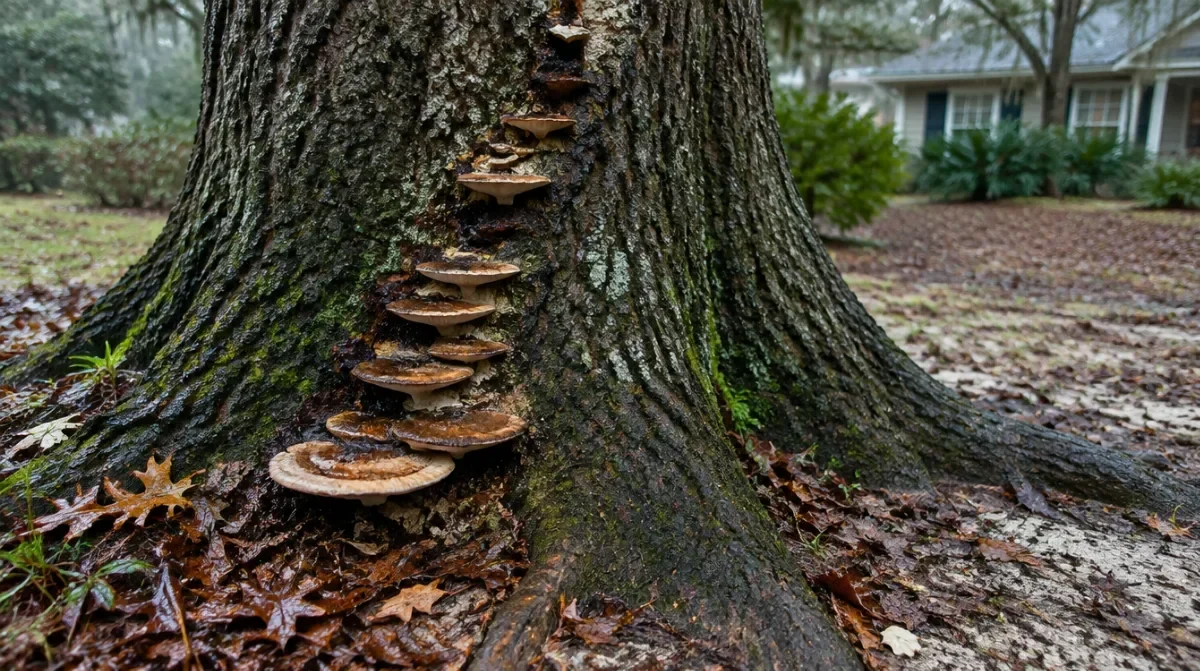
- Is there fungus at the base or a cavity low on the trunk.
- Has the canopy thinned compared to nearby oaks of the same size.
- Are there dead limbs over anything that matters.
Those are the things that shorten a live oak’s life. We wrote about the long view on that in how long live oaks live, and tree preservation is the work that actually moves the needle.
Frequently Asked Questions
Does Spanish moss kill trees?
No. It is an epiphyte with no roots in the tree and it takes no water or nutrients from it. Trees heavily covered in moss are usually trees that were already thinning for another reason.
Should I remove Spanish moss from my oak?
Only for cosmetic reasons. It is not a treatment for a sick tree, and it will not make a limb less likely to break.
Is Spanish moss full of bugs?
Moss hanging in a tree is generally not the chigger reservoir people describe. Moss that has fallen and been lying on the ground can pick up whatever is in the leaf litter, so do not bring that indoors without drying or heating it.
Can I spray something to get rid of it?
Copper-based products are sometimes marketed for this. We would not put them on a mature live oak. Coverage is difficult, damage to foliage is possible, and the benefit is purely cosmetic. Hand removal is the safer route if you want it gone.
Why does one tree in my yard have moss and the one beside it does not?
Light, humidity and bark texture. Rough-barked trees with open canopies in moist, still air collect it. A tight dense canopy or a smooth-barked species on a breezy, sunny side of the lot may stay nearly clear.
Read the Tree, Not the Moss
If somebody knocks on your door offering to save your oaks by stripping the Spanish moss out of them, that is a sales pitch, not an arborist’s recommendation.
Look at the canopy, the trunk and the base instead. That is where the answer is. And if the tree does turn out to be thinning, the sooner somebody looks at it the more options there usually are.
Want a straight opinion on one of your oaks? Request a free estimate or call (912) 342-0440.