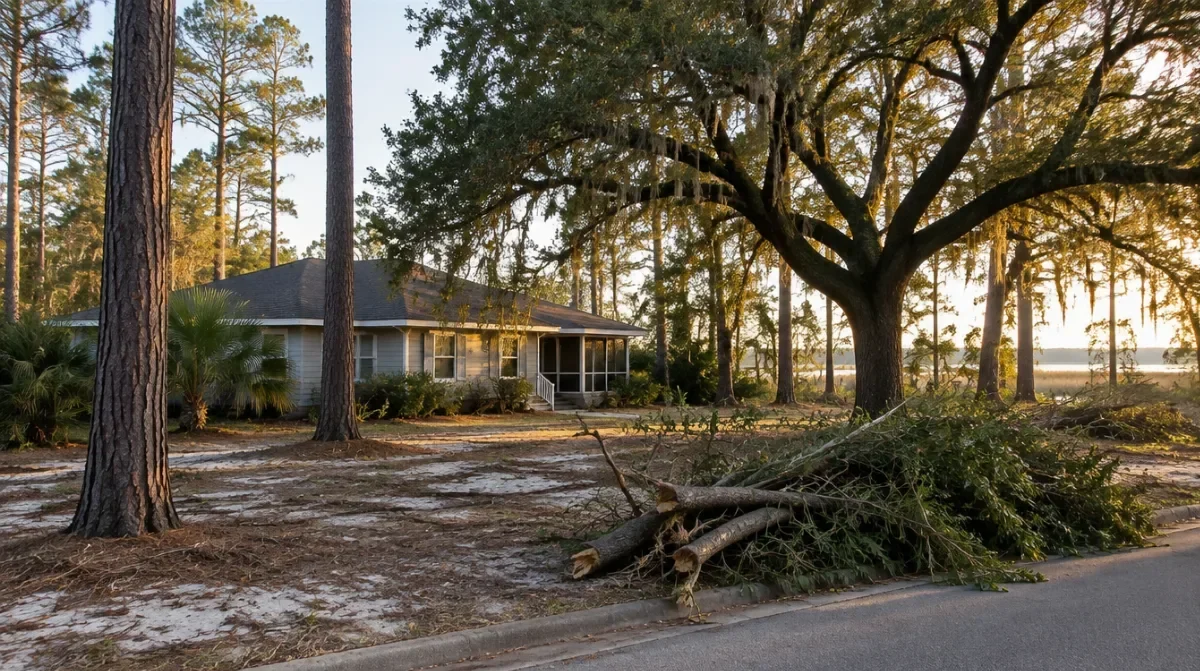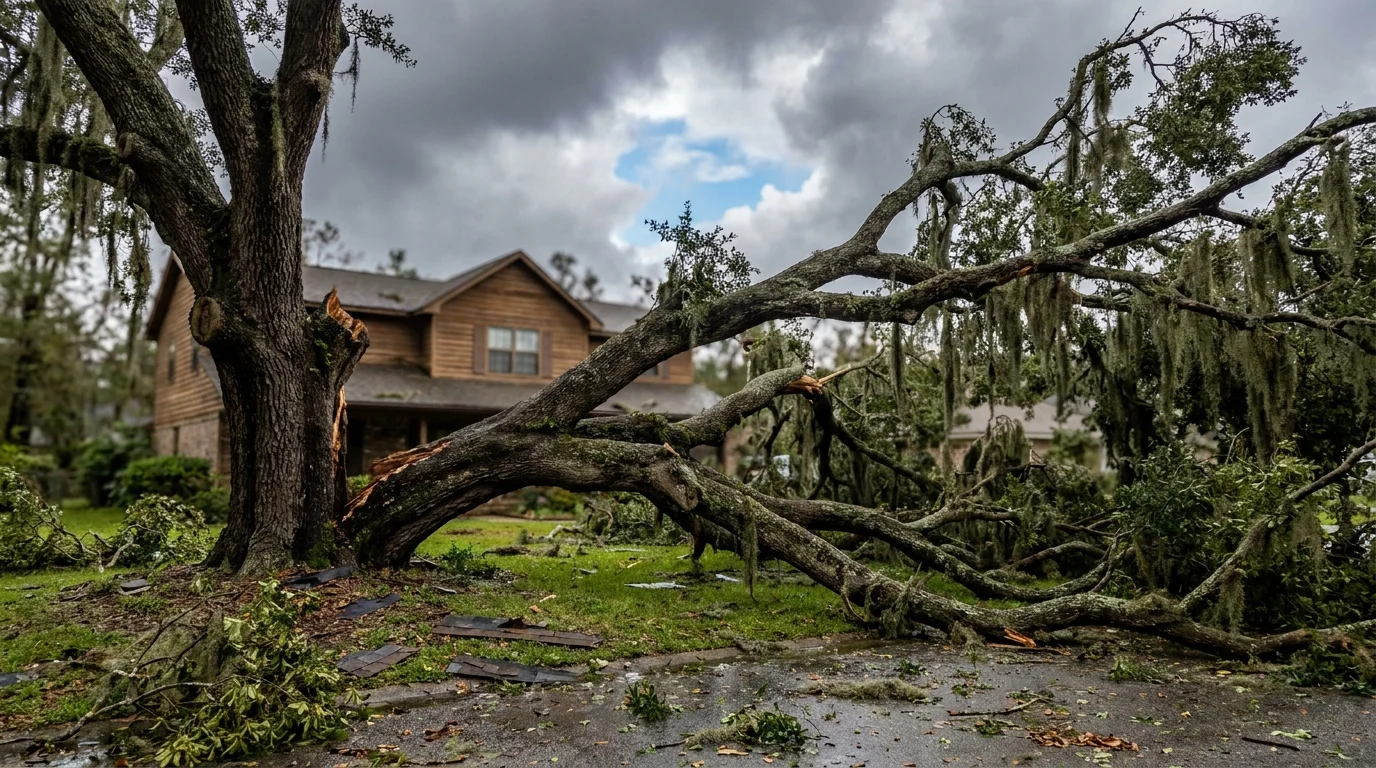
There is nothing else in coastal Georgia that looks like a big live oak lit up for Christmas. The moss catches the light, the whole canopy glows, and you can see it from three houses down.
There is also nothing else that puts more homeowners on a ladder in December, in the dark, with a staple gun. Every year a few trees get damage from it that shows up two summers later, and every year people come off ladders doing it.
We are LoyalTree LLC, family-owned out of Guyton. Mike Williams has 20+ years of hands-on tree experience. Here is how to light a big tree without hurting it or yourself.
Key Takeaways
- Never staple, nail, screw or tack anything into a tree. Every puncture is a wound and an entry point for decay.
- Wrap loosely and leave slack. Anything tight around a limb can girdle it as the tree grows.
- Take the lights down in January. Lights left up for years are the most common way trees get damaged by decorating.
- Use outdoor-rated lights and a GFCI outlet, and keep connections up off wet ground.
- If you cannot reach it standing on the ground, do not reach it off a ladder with a pole.
What Actually Hurts a Tree
Fasteners
Staples, nails, screws, eye hooks, tacks, anything you drive into the bark. Trees do not heal punctures the way skin does. They wall the damage off and grow around it, which means the wound is still in there, and every one of those holes is a door for decay fungi and boring insects.
One staple will not kill a live oak. Four hundred staples a year for a decade is a different story, and it is exactly what happens when people staple a string up and then leave it.
Anything tight around a limb
Zip ties, wire, twine pulled snug, even a light string wound tight. A branch grows in diameter every year. Whatever is around it does not. Given enough seasons it cuts into the bark and strangles the flow of water and nutrients past that point, and everything beyond it dies.
We see this constantly, and almost never on something somebody put up last month. It is always the thing that has been there for five years.
Leaving it up
Lights left in a tree year-round get grown over, trap moisture against bark, and become a genuine hazard for anybody who later has to prune or climb that tree. A climber putting a saw into a hidden wire is a bad afternoon.
Heat, mostly a non-issue now
Old incandescent bulbs did run hot enough to scorch foliage they rested against. Modern LED strings generate far less heat, which takes most of the scorch risk off the table. LEDs also draw a fraction of the power, which matters when you are running a lot of strings off one circuit.
How to Do It Right
Wrap, do not attach
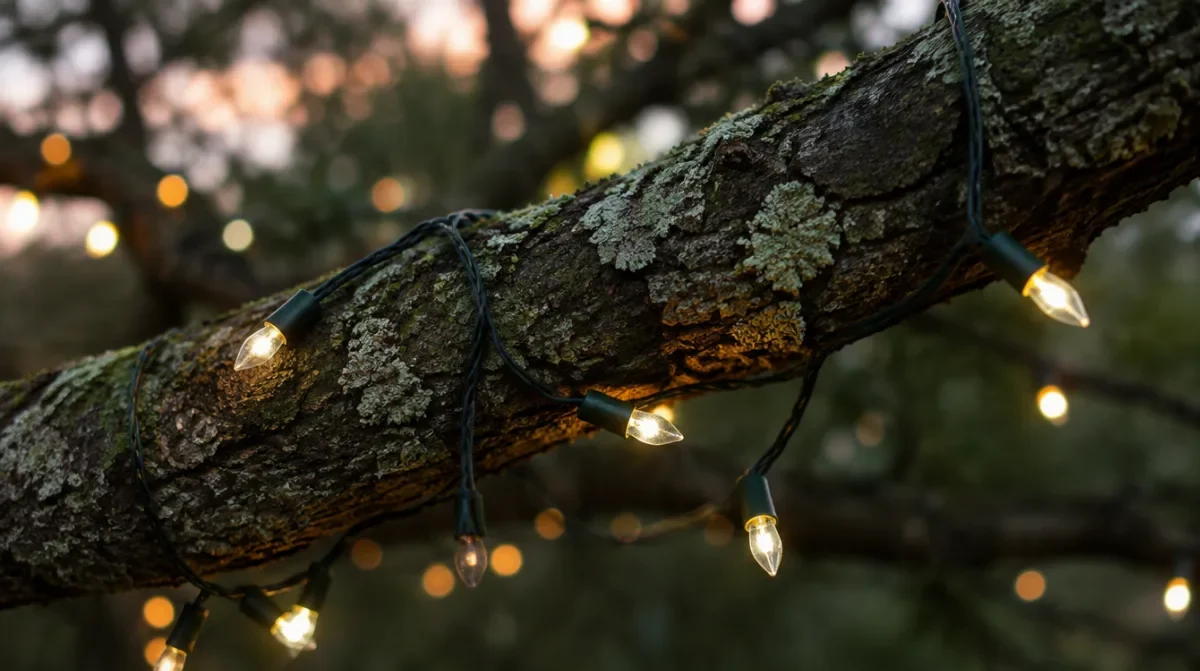
The whole method is wrapping. Spiral the string around the trunk and out along the limbs, and let friction hold it. Bark is rough enough, especially on an oak, that a wrapped string stays put fine.
Leave slack at every turn. You should be able to slide a couple of fingers under the cord anywhere along it. If you have to pull to make it look neat, it is too tight.
If you need to secure something
Use soft, wide material: a strip of cloth, a piece of old garden hose over a tie, arborist-grade tree tape. Tie it loosely, and put a piece of flagging tape on it so you can find it again in January. Never wire, never zip ties, never anything thin and strong.
Work from the trunk out
Start at the base, spiral up the trunk, then follow the main limbs outward. On a spreading live oak you get the most effect from lighting the trunk and the first big limbs rather than trying to cover the whole canopy. Uplighting from the ground is the other option and it does a lot with very little, especially on a mossy oak.
Get the electrical right
- Outdoor-rated lights and outdoor-rated extension cords only.
- Plug into a GFCI outlet, or use a portable GFCI adapter.
- Keep plug connections off the ground and wrapped or covered against rain.
- Do not exceed the number of strings the manufacturer says can be connected end to end.
- Put the whole thing on a timer so it is not running unattended all night.
- Inspect strings before they go up. Cracked insulation or a chewed cord goes in the trash.
Take them down
January. Not next December. This is the single most important item on the list and it is the one everybody skips.
The Ladder Problem
Here is the part we care about most, because it is the part that actually hurts people.
The Consumer Product Safety Commission estimates about 14,800 people a season are treated in emergency rooms for holiday decorating injuries, roughly 160 a day, and more than 40 percent of those incidents involve falls. The circumstances are usually the same: a ladder on uneven ground, leaned against something round, reaching sideways, in cold weather, often in fading light, usually alone.
Rules we would give anybody:
- Never lean a ladder against a tree limb or trunk. A round surface offers nothing to stabilize the top of a ladder, and limbs move.
- Do not reach. Keep your belt buckle between the rails. If you have to lean out, get down and move the ladder.
- Do not go up alone. Somebody should be footing the ladder and holding your phone.
- Do not climb into a tree to hang lights. Climbing a tree safely is rope work and training, not enthusiasm.
- Stop at what you can reach from the ground with a pole. Honestly, a beautifully lit trunk and lower limbs looks better than a half-finished canopy anyway.
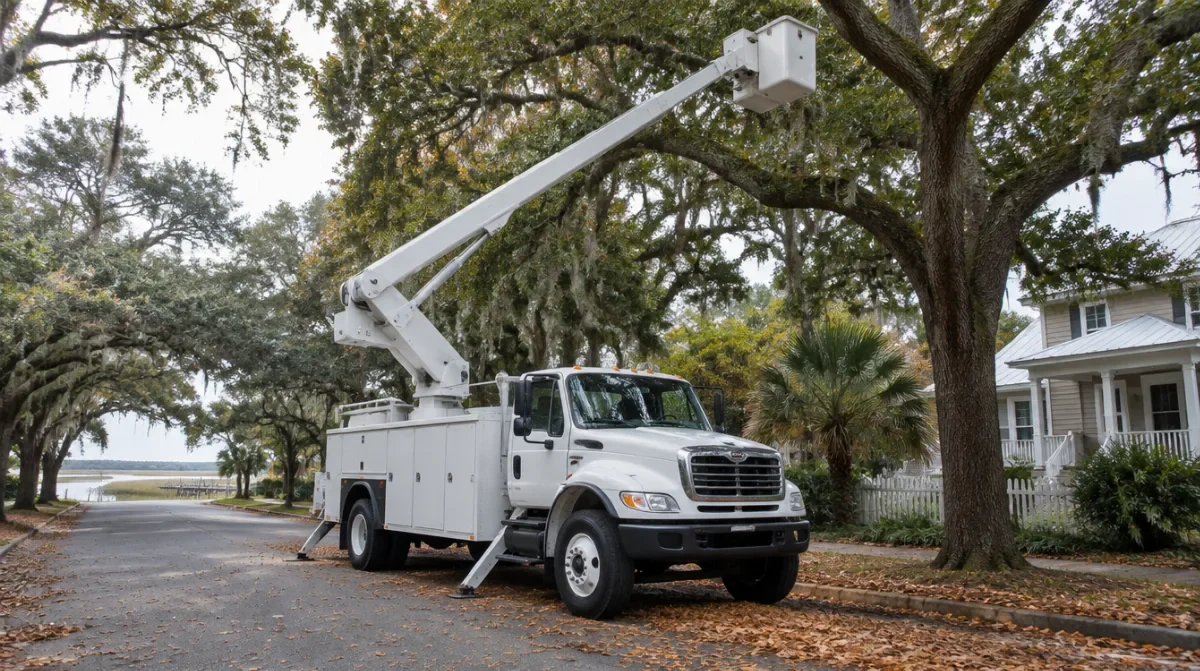
If the tree is large and you want the upper canopy lit, that is a job for somebody with a bucket truck or a climber on rope. Our article on what an arborist actually does covers where the line is between a homeowner job and a crew job.
While You Are Looking Up There
One practical thing: decorating is the one time of year most people really study their own tree. Use it.
If you find a dead limb over the driveway while you are wrapping the trunk, note it. If a union looks split, note it. If there is fungus at the base you had not noticed, definitely note it. December is a good month to get that work done anyway, because the tree is dormant and the ground is firm. Our guide on the tree to-do list after hurricane season covers what winter is good for.
Frequently Asked Questions
Can I staple Christmas lights to a tree?
No. Every staple is a wound in the bark and a possible entry point for decay and insects. Wrap the string around the limb instead and let friction hold it.
Do Christmas lights hurt trees?
Properly wrapped LED lights taken down after the season do essentially no harm. Damage comes from fasteners driven into bark, anything tight enough to girdle a growing limb, and strings left up for years.
Can I leave the lights up all year?
We would not. The tree grows into them, moisture gets trapped against the bark, and hidden wire in a canopy is dangerous for anybody who later prunes or climbs that tree.
How many lights do I need for a big live oak?
More than you think, and it depends on how tightly you wrap. Measure the trunk height and the length of the limbs you plan to cover, then plan your spacing. Buying a couple of extra strings is easier than matching color temperature later.
Is it safe to light a tree with Spanish moss in it?
It looks terrific, and LEDs put out far less heat than the old incandescent bulbs, which we would not rest in dry moss. The thing to be careful about is not the bulbs, it is the wiring: outdoor-rated strings with no cracked sockets or frayed cord, a GFCI outlet, connections up off wet ground, and a timer. More on the moss itself in is Spanish moss killing your tree.
Light It, Then Unlight It
Wrap loosely, put nothing metal into the bark, keep your feet on the ground, and take it all down in January. Do those four things and you can light the same oak every year for fifty years without doing it any meaningful harm.
And if you spot something up there you do not like the look of while you are working, request a free estimate or call (912) 342-0440.