You know the tree. Perfect lollipop shape, covered in white flowers in early spring, planted by the dozen in every subdivision built between about 1985 and 2010. Right now it is one of the last things holding color in October, going glossy red and purple along half the streets in Pooler and Richmond Hill.
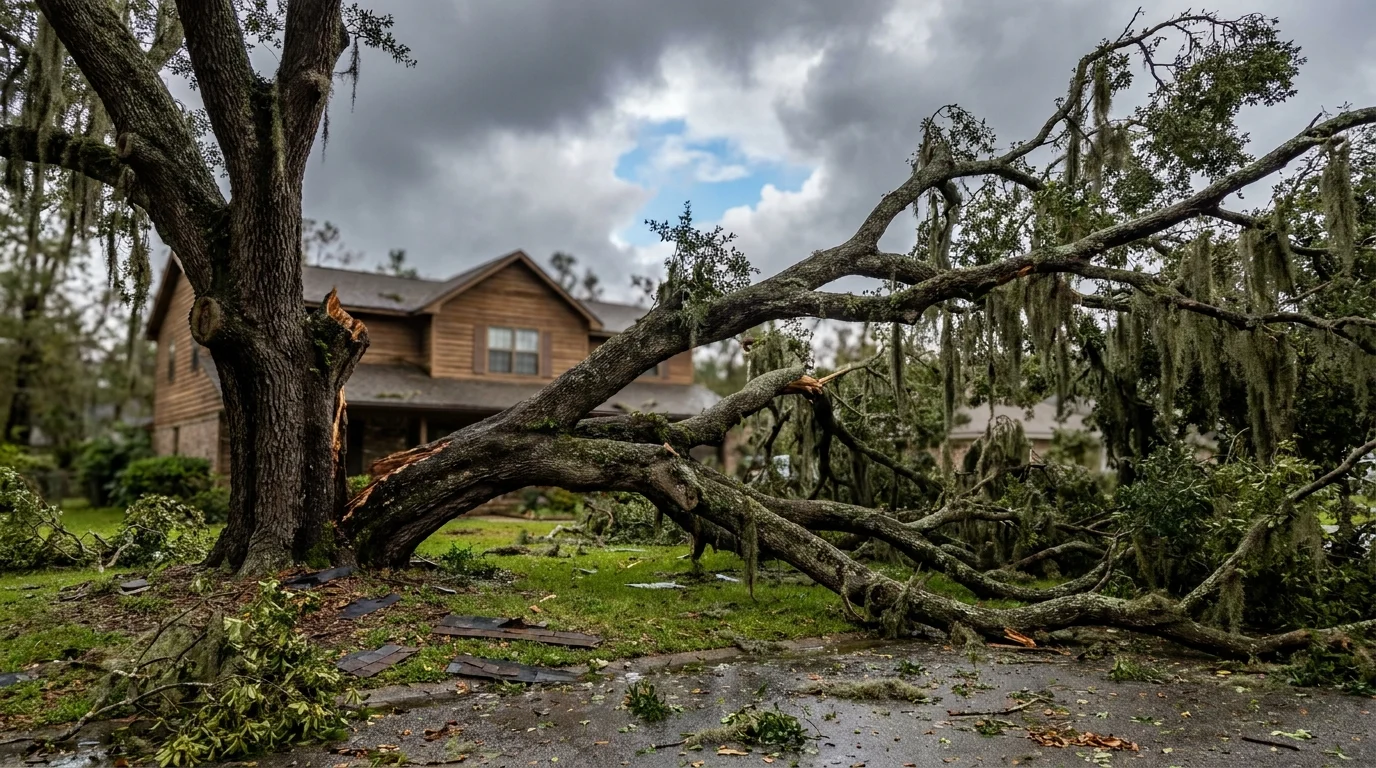
It is also the tree we get called out to more than any other after a summer storm, usually because half of it is lying in the driveway.
We are LoyalTree LLC, family-owned out of Guyton. Mike Williams has 20+ years of hands-on tree experience and has cleaned up a lot of these. Here is why Bradford pears fail the way they do, what the state extension people say about them now, and what to put in the hole instead.
Key Takeaways
- Bradford pears split because of how they are built, not because of how they were cared for.
- UGA Extension puts their useful life at roughly 10 to 15 years, with 20 being exceptional.
- Pruning can slow the problem down but cannot fix the branch structure.
- Their wild offspring are spreading fast across the South and grow serious thorns.
- Fall is a good time to take one out and plant a replacement in coastal Georgia.
Why They Split
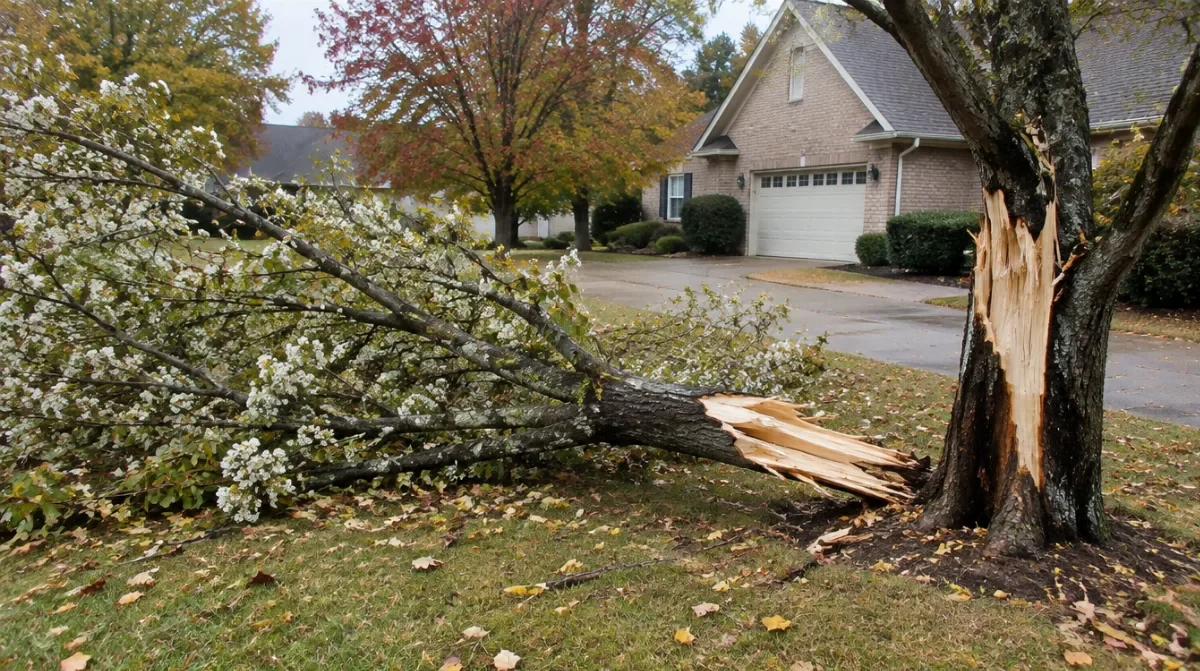
Look up into a Bradford pear and you will see the problem. Instead of one main trunk with branches coming off it at wide angles, you get a whole bundle of near-vertical stems all originating from roughly the same point a few feet off the ground. They crowd against each other as they thicken, and bark gets pinched down inside every one of those joints.
Included bark like that means there is very little actual wood connecting the limb to the trunk. It is a seam, not a weld. UGA Extension agent Paul Pugliese describes the species as having a very weak, vertical branching structure that is notorious for splitting and breaking, and notes that the trees are genetically programmed to grow that way.
What that means in practice: the tree grows fast, gets tall and heavy, and then somewhere around ten to fifteen years the first real wind event peels a third of it off. UGA puts the typical lifespan at 10 to 15 years, with 20 being unusual. On the Georgia coast, with the wind loading we get, they rarely beat that.
It is not a maintenance failure. We see beautifully kept Bradford pears come apart on a calm afternoon.
The Other Problem: They Escaped
Bradford pears were sold as sterile. On their own, a Bradford cannot pollinate itself. But once nurseries introduced other Callery pear cultivars, and once grafted trees got damaged and started sprouting from their rootstock, the different types started crossing. Those crosses produce fertile fruit.
Birds eat the fruit and drop the seed everywhere: fence lines, ditch banks, powerline right-of-ways, the edge of every field between here and Springfield. The wild offspring start fruiting at around three years old, so it compounds quickly. UGA describes them as quickly becoming as invasive as Chinese privet and kudzu, which is not a comparison anybody makes lightly around here.
The wild ones also revert to the ancestral form, which means thorns. Not rose thorns. Long, hard, tire-puncturing thorns on trunk and branches. Anybody who has tried to clear a fence line that has gone to wild pear knows exactly what we are talking about, and it is one of the nastier jobs in vegetation management.
Several states have moved to ban the sale of Callery pear outright. If you are on the South Carolina side of our service area, Clemson Extension and the SC Forestry Commission run a Bradford Pear Bounty that swaps up to five removed Bradford pears for free native replacement trees, one for one. You pre-register, cut the tree down yourself, bring photo proof to the event, and pick up your replacements first come, first served. Worth knowing if you are in Bluffton, Beaufort or on Hilton Head, though the events rotate around the state and none has been held in Beaufort County yet, so check the schedule before you count on it.
Can You Save the One in Your Yard?
Partly, and only for a while. Here is the honest range of options.
If it is young, structural pruning helps
On a tree under about eight or ten years old, a good crew can pick a single dominant leader, remove the competing stems, and space out the remaining branches. That genuinely buys years. It has to be done before the stems get big, and it has to be done by somebody who knows what they are selecting for.
If it is mature, you are managing the decline
Once those codominant stems are six inches thick with bark buried in the union, you cannot undo it. Crown reduction lowers the sail area and takes some leverage off the joints, which reduces risk. Cabling and bracing can hold a valuable specimen together, and on a Bradford it is usually a delay rather than a cure. Both of those are maintained systems that need re-inspection.
What not to do
Do not let anybody top it. Tree topping on a Bradford pear produces exactly the thing that fails: a crowd of fast, upright, weakly attached shoots, sitting on top of decaying stubs. You end up with a more dangerous tree three years later.
When it is already split
Once a Bradford has lost a major stem, the remaining tree is usually lopsided, the wound will not close well, and the other unions are carrying more load than before. Most of the time the right call is to take the whole thing out rather than do the job twice. If it came down on something, our article on a tree falling on your house in Georgia walks through the first steps.
Killing the Stump So It Does Not Come Back
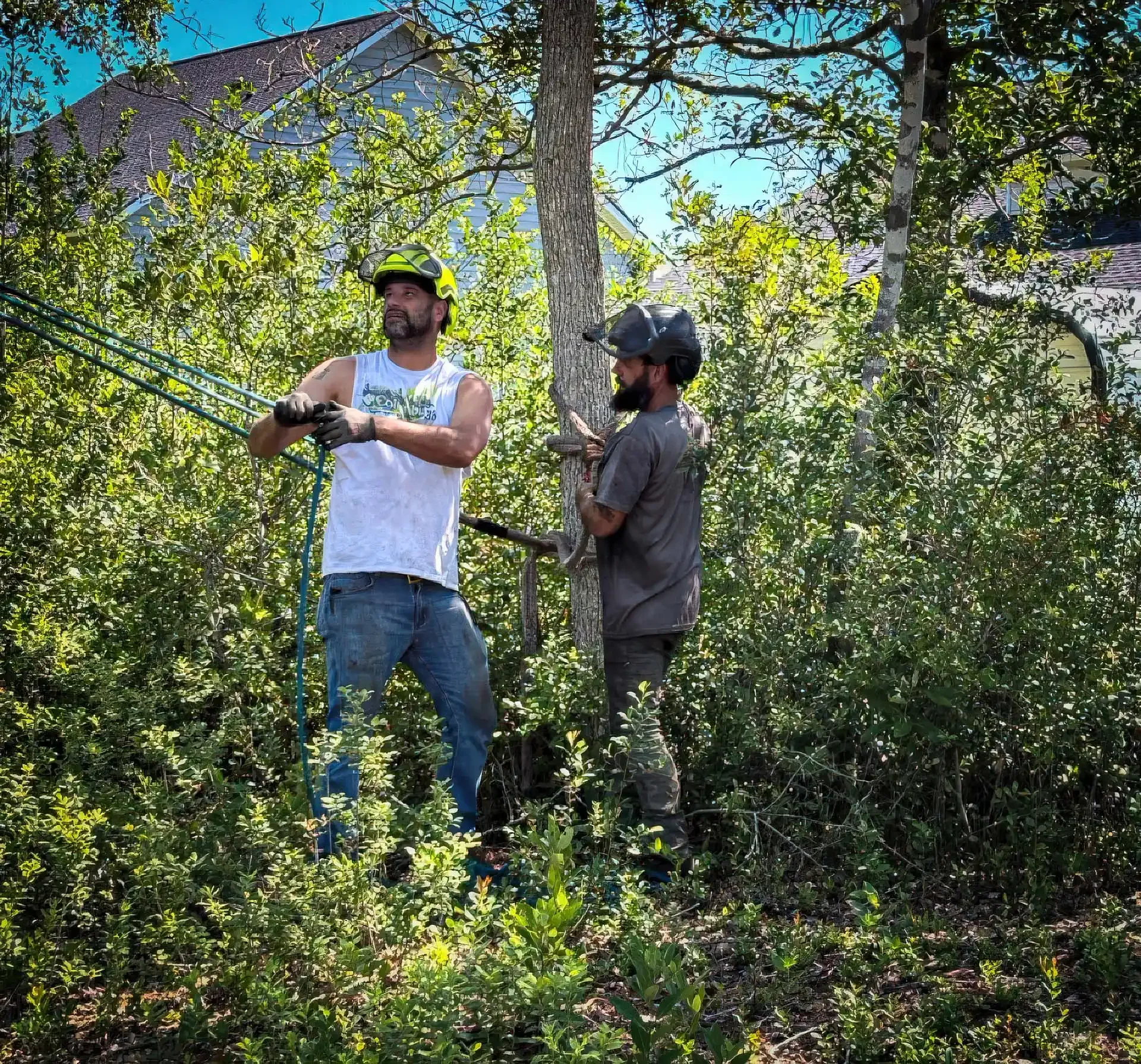
This part matters more with pear than with most trees. Cut a Callery pear off at the ground and walk away, and it will send up a thicket of sprouts, and those sprouts are the thorny wild type. UGA’s guidance for infested areas is to cut the tree and treat the fresh stump with an herbicide containing glyphosate or triclopyr, applied right after the cut while the stump is still taking up material.
Grinding the stump is the other route and it takes the sprouting problem with it. There is more on that choice in stump grinding versus stump removal, and on why stumps sprout in do tree stumps grow back.
What to Plant Instead
If what you liked was the spring bloom at roughly that size, there are better trees for coastal Georgia that give you the same thing and last a lot longer:
- Serviceberry for early white flowers, plus fruit and fall color.
- Eastern redbud for the earliest color of the year, and it is tough.
- Flowering dogwood for the classic white spring show in part shade.
- Fringetree, a native, underused, and one of the best-smelling trees we have.
- American holly or yaupon if you want evergreen structure and winter berries instead.
- Southern magnolia or live oak if you actually want a long-term shade tree in that spot.
Fall is a good planting window here. Our winters are mild enough that roots keep developing, and the new tree goes into next summer already established.
Frequently Asked Questions
How long do Bradford pear trees live?
UGA Extension puts it at roughly 10 to 15 years of useful life, with 20 being exceptional. After that, wind loading or a storm generally takes them apart.
Are Bradford pears illegal in Georgia?
We are not aware of a statewide sales ban in Georgia, though several other states have enacted one and Callery pear is widely listed as invasive. Check with the Georgia Department of Agriculture for the current status, and check your HOA rules before removing or planting anything.
Will pruning stop my Bradford pear from splitting?
Structural pruning on a young tree helps and can add years. On a mature tree with thick codominant stems, pruning reduces risk but cannot fix the underlying branch attachment.
Why does my Bradford pear smell bad in spring?
The flowers give off butyric acid and related compounds, which is why a whole street of them in bloom smells the way it does. It is normal for the species.
Do I need a permit to remove one?
It depends on your jurisdiction and your HOA. Requirements differ between unincorporated Effingham County, Savannah, Pooler and Richmond Hill. We covered what to check in do you need a permit to cut down a tree in Georgia.
A Tree Worth Replacing on Your Schedule
The thing about a Bradford pear is that you know how the story ends. It is going to come apart. The only question is whether that happens on a Tuesday with a crew and a chipper, or at two in the morning in forty-mile wind with half of it on the car.
Taking one out in the fall and putting in something that will still be there in fifty years is one of the better trades a homeowner can make.
If you have one you have been eyeing nervously, request a free estimate or call (912) 342-0440.