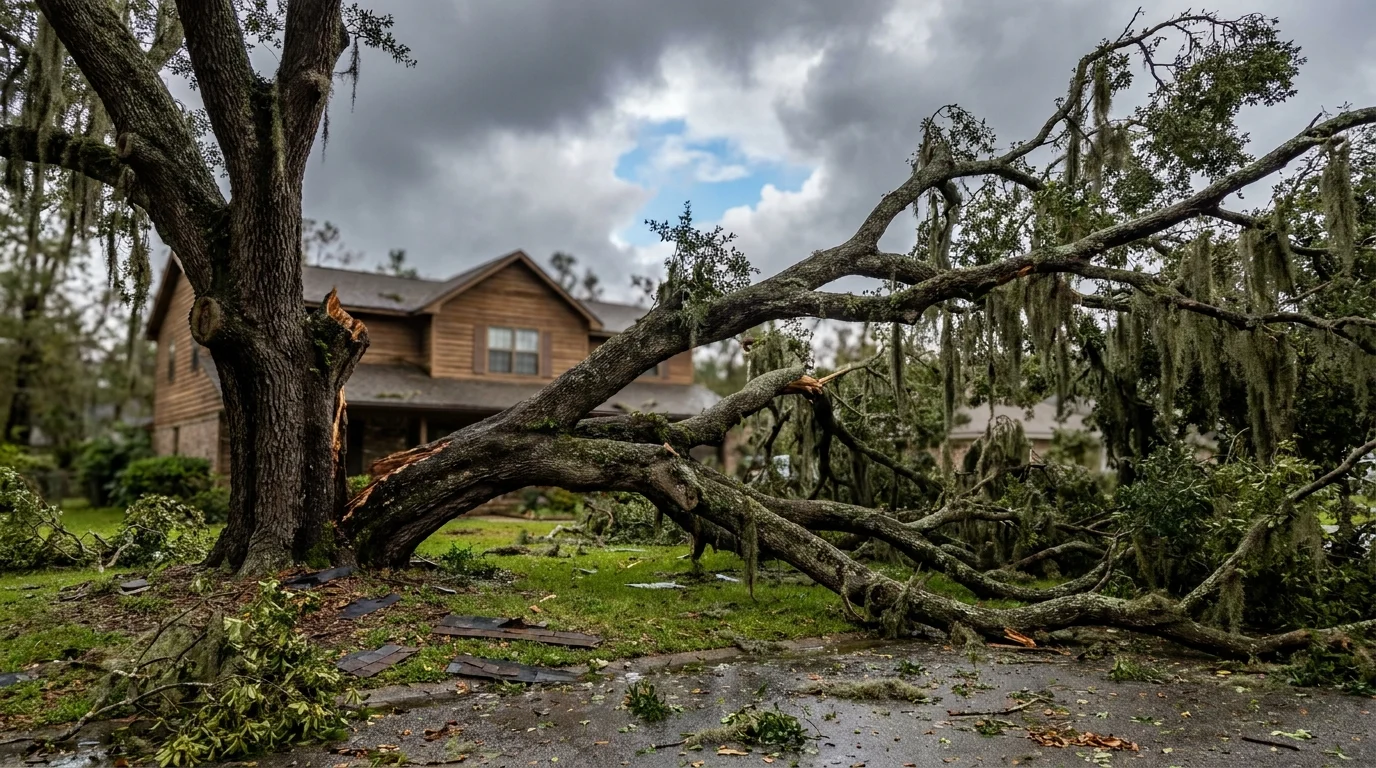
If we had to name the one tree that gets called in most often around Savannah, Rincon and Richmond Hill, it would not be the live oak everybody worries about. It would be the water oak.
Water oaks are everywhere here. They came up fast in yards and along fence lines, they give good shade, and for thirty or forty years they look like a great tree to have. Then something changes. The canopy thins, limbs start dropping in calm weather, and one day a storm takes the whole thing over sideways with a trunk that turns out to be hollow.
We are LoyalTree LLC, family-owned and based in Guyton. Mike Williams has 20+ years of hands-on tree experience and has cut apart more failed water oaks than he can count. Here is what makes this tree different, how to tell yours is getting on, and what your real options are.
Key Takeaways
- Water oaks grow fast, get big, and have a much shorter useful life than live oaks.
- They tend to decay from the inside while still looking full on the outside.
- Almost every one we have cut apart failed at a weak trunk union or a rotted spot low on the stem.
- Falling limbs in calm weather, fungus at the base and crown dieback are the warning signs worth acting on.
- A water oak near the house is worth an honest look well before it becomes a storm problem.
How to Tell a Water Oak From a Live Oak
People mix these up constantly, and the difference matters because they behave nothing alike.
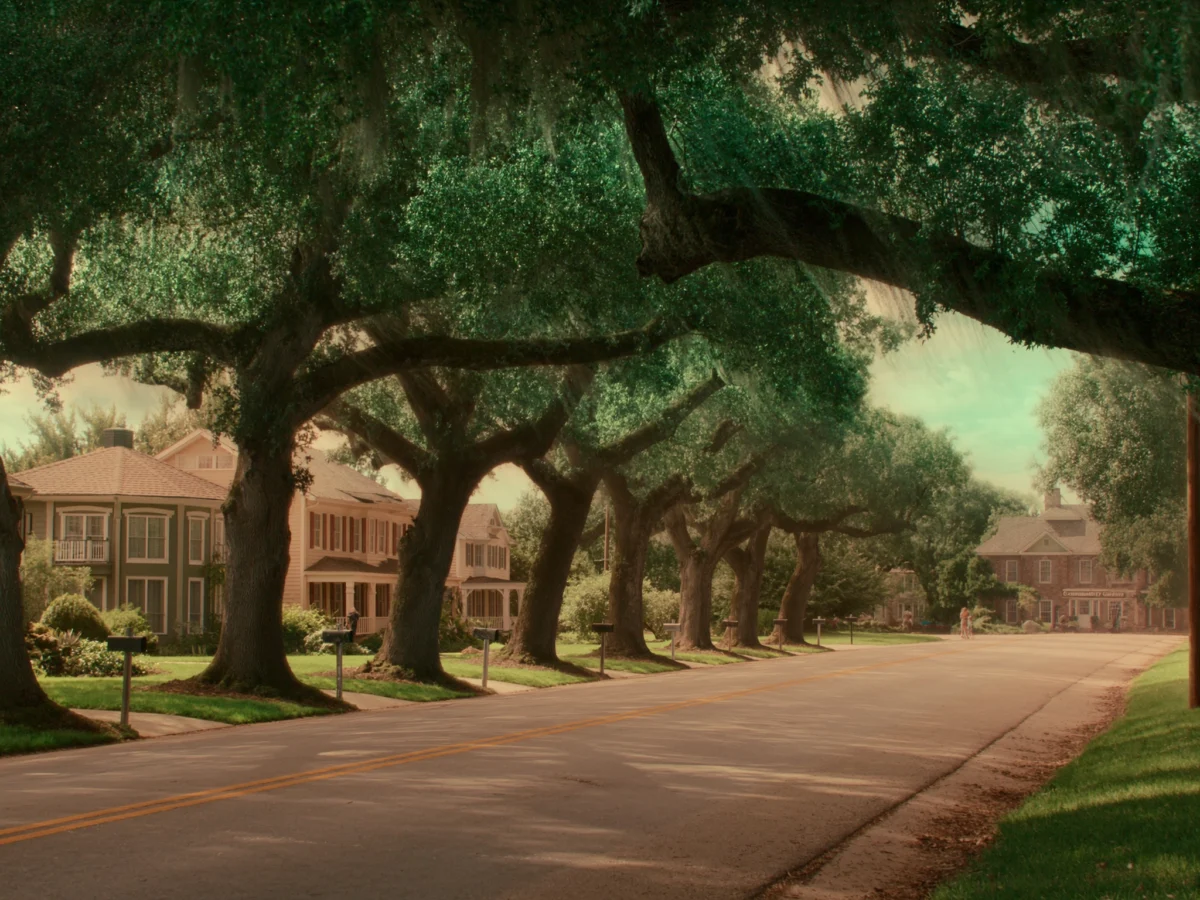
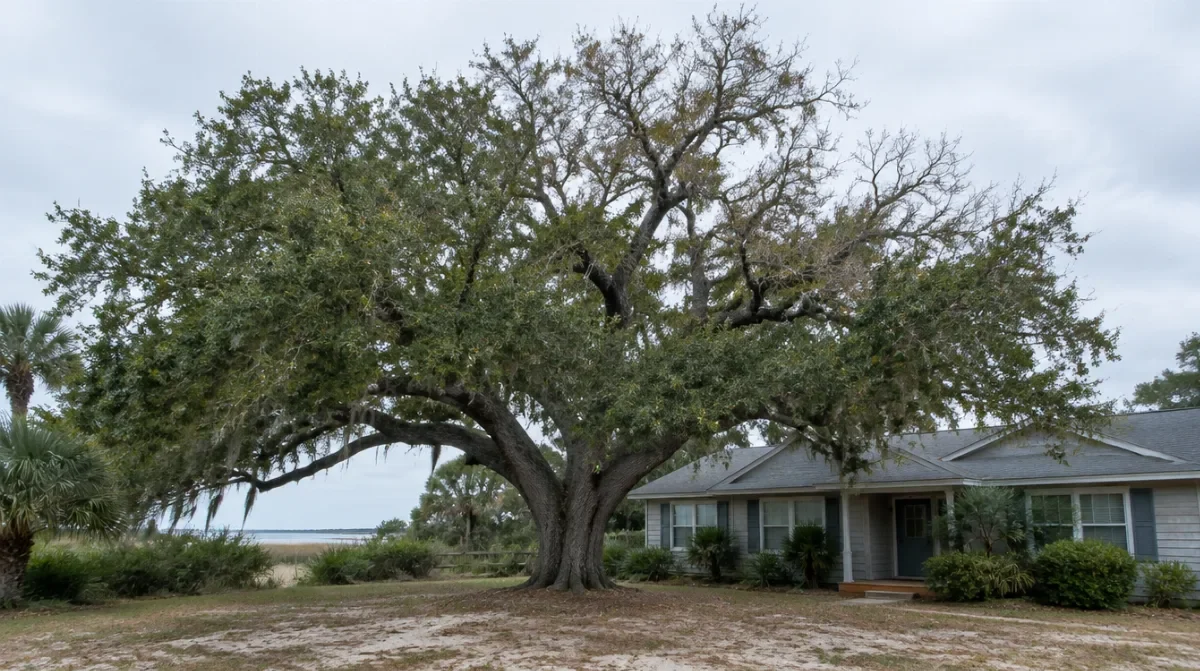
A live oak is the wide, low, spreading tree that holds its leaves all winter, carries Spanish moss, and grows out sideways as much as up. The leaves are small, thick, leathery and dark green with smooth edges.
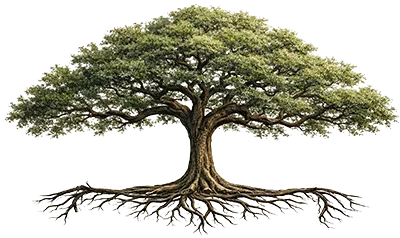
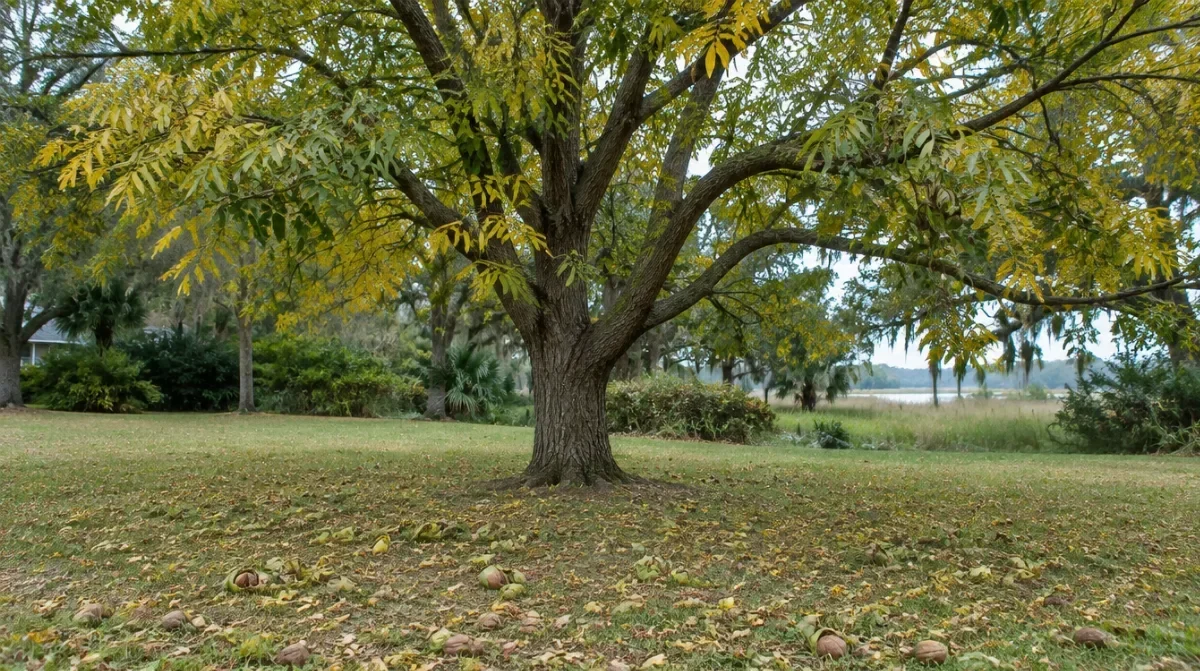
A water oak grows up rather than out, usually with one straight trunk and a rounded or oval crown. The leaves are the giveaway: thin, dull green, wider at the tip than the base, often shaped a bit like a spatula or a duck’s foot. They turn brown and drop through late fall and winter, and they are a big part of the leaf load people rake around here.
Laurel oaks are close cousins and have most of the same problems. You will hear water oaks called duck oak or possum oak around here. If somebody calls one a pin oak, that is a different tree entirely.
Why Water Oaks Fail Sooner Than You Expect
The short version: fast growth, soft wood, poor decay resistance.
A live oak lays down dense, heavy wood and can push well past a century in good conditions. We wrote about that in how long live oaks live. A water oak does the opposite. It races up, puts on wide growth rings of comparatively soft wood, and reaches full size in a few decades. That is why people plant them and love them early.
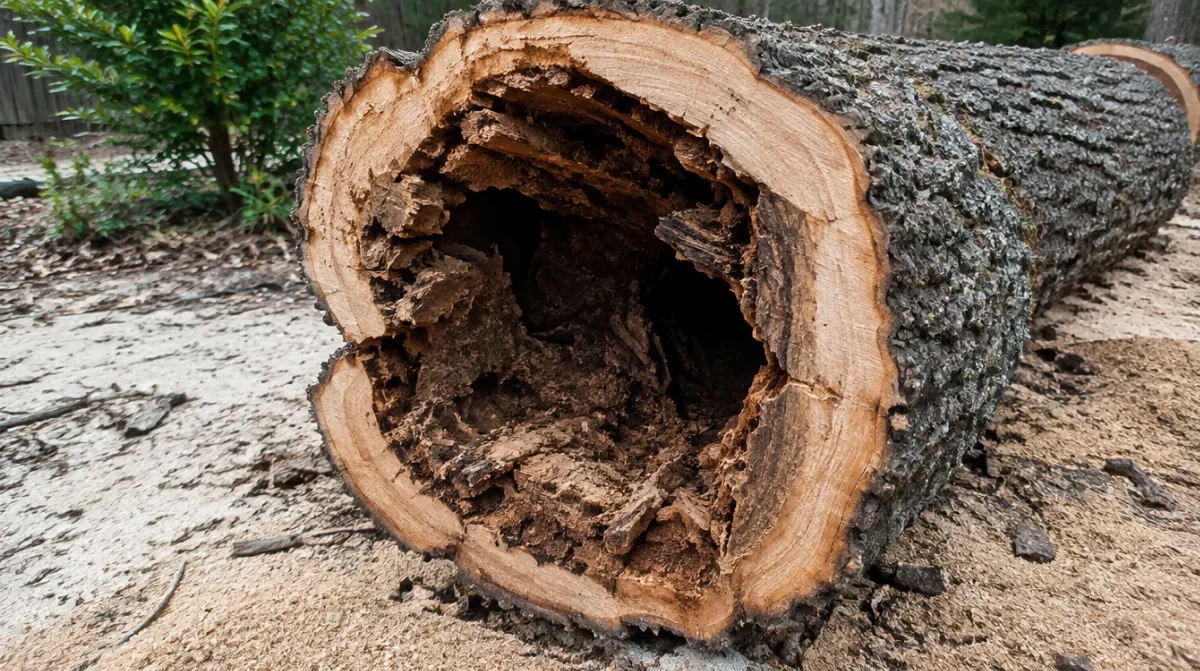
The trouble is that water oak wood does not fight decay well. Any wound, a broken limb, a mower strike, a bad pruning cut, a lightning scar, becomes an entry point. Fungus gets in, works down the inside of the trunk, and hollows the tree from the center out while the outer ring of living wood keeps pushing leaves. From the driveway the tree looks fine. It is not fine.
Two other things stack on top of that here on the coast:
- Weak forks. Water oaks commonly grow two or three codominant stems out of one point, with bark pinched down inside the union. That joint has very little real wood holding it together, and it is the single most common failure point we see.
- Shallow roots and saturated ground. Water oaks root shallow. Add a saturated week and forty-mile wind and the whole root plate can lift. UF research puts water oak and laurel oak in the lowest wind-resistance group for the Southeastern coastal plain, while live oak sits in the highest. Our article on what tree roots actually do covers how root systems behave in this soil.
The Warning Signs on a Water Oak
Because the decay is on the inside, you have to read the outside carefully. Here is what we look at, roughly in order of how much it worries us.
Limbs falling on calm days
This is the one people mention casually and it is the one that matters most. If limbs the size of your arm or bigger are coming out of the tree with no wind behind them, the tree is shedding. That is a mature water oak telling you it cannot support itself.
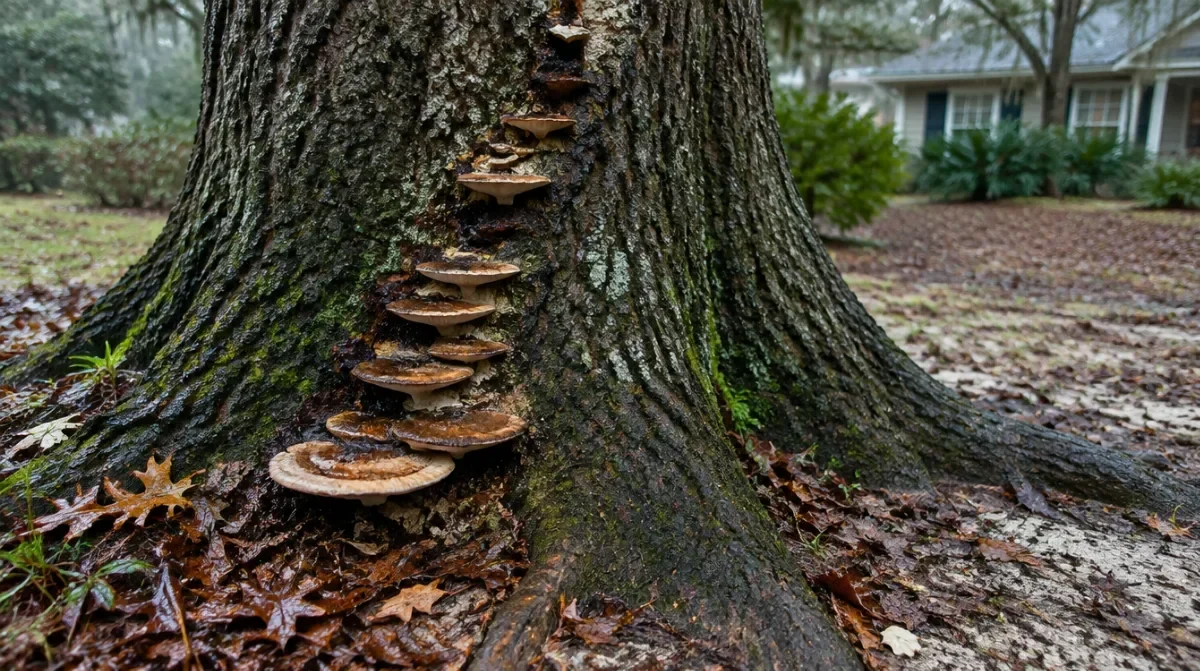
Mushrooms or shelf fungus at the base
Fungal fruiting bodies at the root flare or on the lower trunk mean decay is already well established inside. By the time a mushroom shows up on the outside, the fungus has been working in there a while.
A cavity, a seam, or a soft spot
Look for holes, open wounds, a vertical seam running up the trunk, or an area where the bark sounds hollow when you knock on it. Squirrels moving in and out of a hole in the trunk is a clue, not a charm.
Crown dieback from the top down
Water oaks in decline usually go bare at the very top first, the tallest twigs and branch tips turning grey while the lower canopy still leafs out. That is called stag-heading, and it usually means the roots or the inside of the trunk are no longer supporting the top.
Early or heavy leaf drop
If yours goes bare several weeks ahead of the other water oaks on the street, that is a real signal. Our guide on how to tell if a tree is dead or just struggling gets into more of these.
Can a Water Oak Be Saved?
Sometimes, and it depends entirely on where the problem is.
Problems in the branches are usually fixable. Deadwood can be cleaned out. A heavy limb over the roof can be reduced or removed. A young weak fork can sometimes be pruned to favor one stem. On a valuable tree with a split union that is otherwise sound, cabling and bracing can buy real years. That is a maintained system, not a one-time fix, and it has to be inspected.
Problems in the trunk and roots usually are not. There is no treatment that puts wood back into a hollow stem. If the base is decayed, if the root flare has fungus all around it, or if there is a large cavity low on the trunk, the honest answer is that the tree’s remaining life is limited and the question becomes what is underneath it.
That last part is the real decision. A hollow water oak at the back of five acres can stand there and be a fine wildlife tree. The same tree twelve feet off a bedroom wall is a different conversation. We laid out that thinking in how close is too close.
What we will not do is top the tree to make it shorter. Topping a water oak is about the worst thing you can do to one. The stubs rot, the regrowth is weakly attached, and in a few years you are back to the same height with a heavier top and a far more dangerous tree.
What to Plant Instead
If a water oak comes out and you want shade back, fall is a good planting window in coastal Georgia. Live oak is the obvious long-game choice if you have room, and southern magnolia, bald cypress, Nuttall oak and American holly all do well in our soil. Give a shade tree real distance from the house and the septic field, and resist the urge to plant it back in the exact same hole.
If the stump is in the way of the new planting or the new bed, stump grinding versus stump removal walks through which one you actually need.
When to Have It Looked At
If you have a water oak or laurel oak over about forty feet within falling distance of the house, the driveway, the power drop or a neighbor’s roof, it is worth a real look. Same if you have seen limbs come down, if there is fungus at the base, or if the top has started going bare.
A tree risk assessment gets you a straight answer about what the tree is doing and how much time it has. We work across Effingham County, Savannah, Pooler, Richmond Hill, Rincon, Springfield and the South Carolina Lowcountry.
Frequently Asked Questions
How long does a water oak live?
Water oaks are generally considered short-lived for an oak, commonly declining somewhere in the range of 30 to 50 years, with internal decay often present by about 40, and sooner in a yard with compacted soil, mower damage or root disturbance. Live oaks in the same yard can run several times that.
My water oak looks perfectly healthy. Should I still worry?
A full canopy is good news, but on this species it is not the whole story, because decay works from the inside. If the tree is mature and sits close to the house, a ground inspection of the trunk and root flare is worth doing even when the leaves look great.
Is a hollow tree always dangerous?
Not automatically. Trees carry load in the outer wood, so a tree can be partly hollow and still be reasonably sound. What matters is how much solid wood is left around the hollow, where the hollow sits, and what would get hit. That is a judgment call that needs eyes on the tree.
Can I just cut the top out to make it safer?
No. Topping makes the tree more dangerous over time and shortens its life. Proper crown reduction by a qualified crew is a different technique and follows the branch structure instead of cutting through it.
Do I need a permit to remove a water oak in Georgia?
It depends on your jurisdiction and your HOA, and rules differ between unincorporated Effingham County, Savannah, Pooler and Richmond Hill. Check before you cut. We covered what to look into in do you need a permit to cut down a tree in Georgia.
Know Which Oak You Have
Not every big oak is a live oak, and the difference changes how much time you have. A live oak next to the house can stand there for a hundred years. A mature water oak in the same spot is a tree on a clock.
The good news is that water oaks give you plenty of notice if you know what to look for: limbs dropping on still days, fungus at the base, a top going grey. None of that has to end badly if somebody looks at it before the next storm does.
If you have an oak you are unsure about, request a free estimate or call (912) 342-0440 and we will tell you straight what we see.