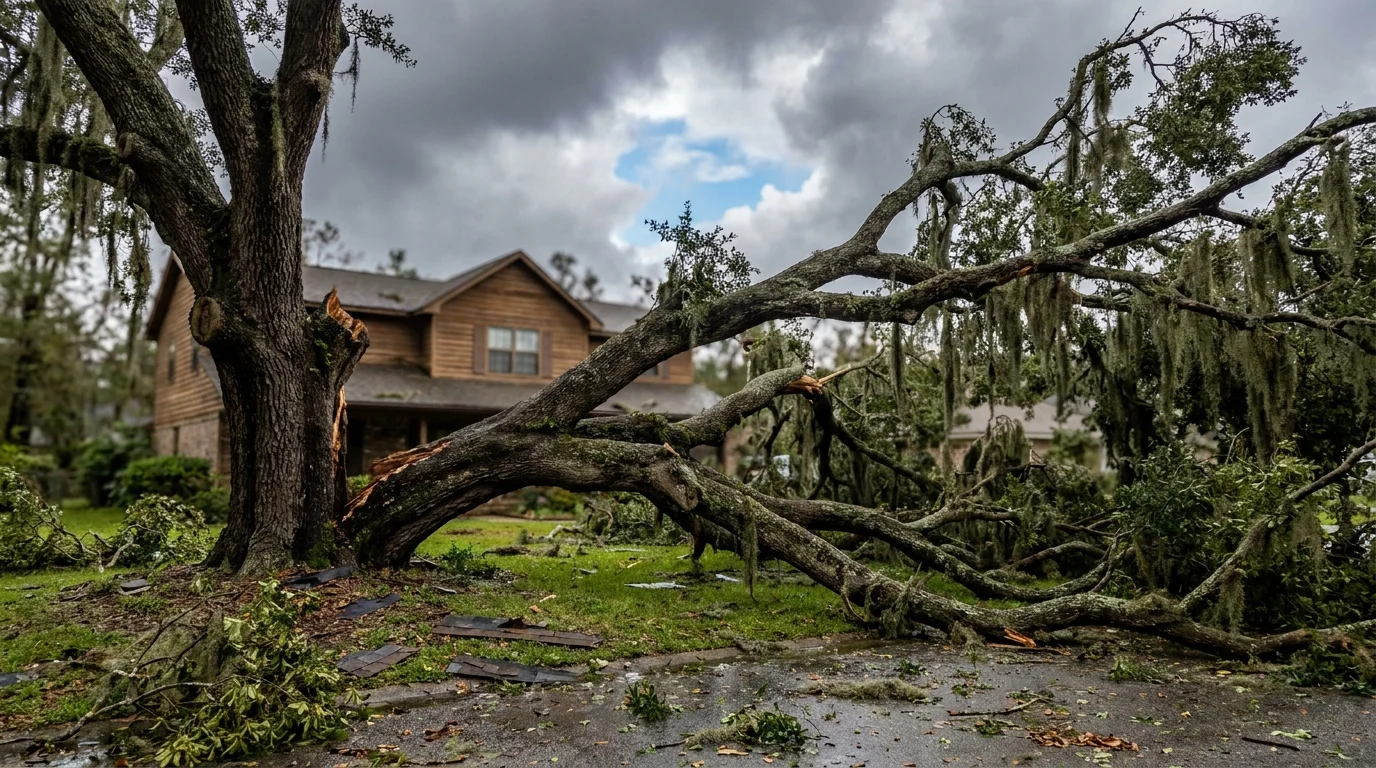
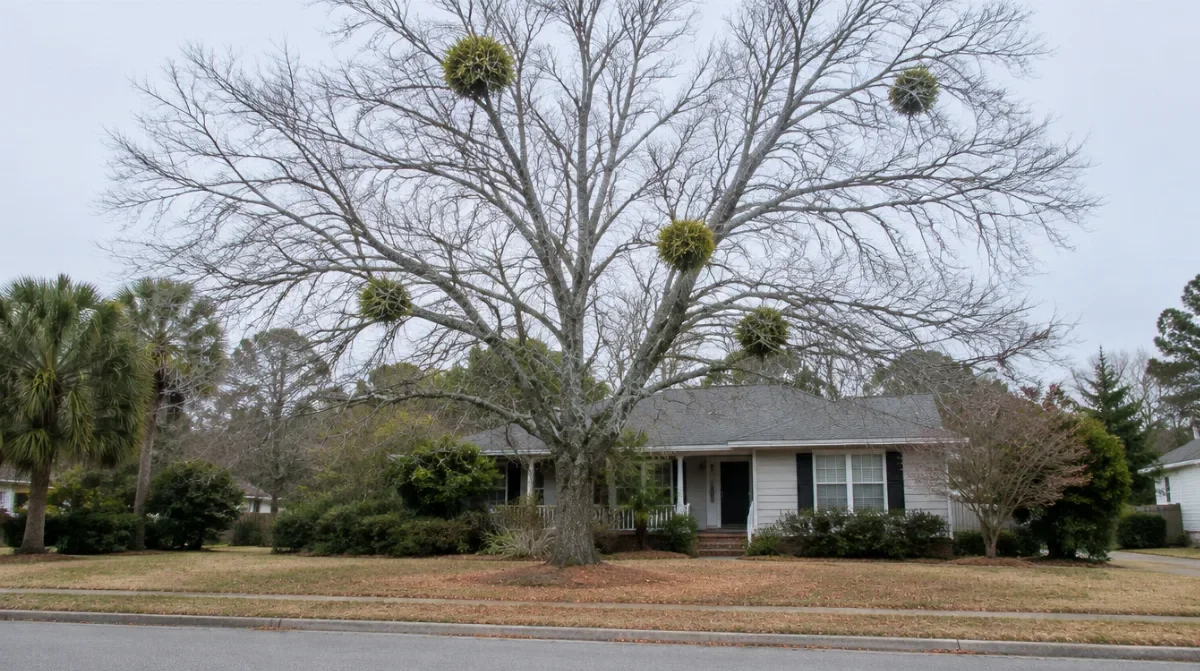
Once the water oaks and pecans go bare in December, you start seeing them: dense green balls sitting up in the grey branches, sometimes one or two, sometimes a dozen in the same tree. From the road they look like squirrel nests. They are not.
That is mistletoe, and the plant you hang in a doorway is genuinely growing into your tree and drinking out of it. It is one of the few things people ask us about that really is a parasite, as opposed to Spanish moss, which everybody blames and which is innocent.
We are LoyalTree LLC, family-owned out of Guyton. Mike Williams has 20+ years of hands-on tree experience. Here is what mistletoe is doing up there and whether you need to do anything about it.
Key Takeaways
- Mistletoe is a genuine parasite of the branch, but a partial one. It grows into the wood and takes water and minerals from the tree.
- It is a hemiparasite, meaning it also photosynthesizes, so it rarely kills a healthy tree outright.
- On the bare-branched hosts it favors, winter is the only time you can easily see it, which is why December is when everybody notices.
- Pulling the green part off will not kill it, because it regrows from tissue embedded inside the branch, though it does stop that plant seeding your other trees.
- The real fix is removing the affected branch well below the attachment, and only when it is worth doing.
What It Is Doing to the Branch
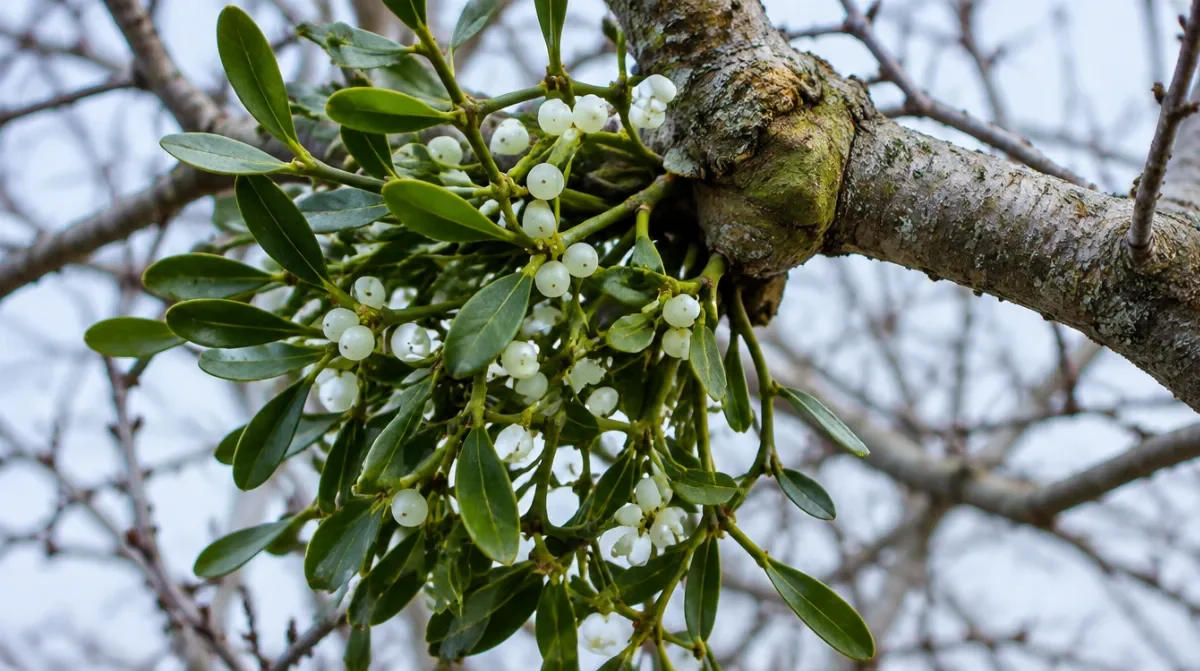
American mistletoe, Phoradendron leucarpum, is the species we have in the Southeast. The genus name comes from Greek for “thief of the tree,” which tells you how long people have understood this.
It does not sit on the branch like Spanish moss. It penetrates. Once a seed germinates on the bark, it sends a structure down through the bark into the wood, and from there runs strands through the branch tissue. Those strands tap directly into the tree’s water-conducting system and pull off water and dissolved minerals.
It does make its own food, which is why it stays green all winter and why it does not simply kill its host. The tree is supplying the water; the mistletoe is handling the rest. That is what a hemiparasite is.
The practical effect on the branch is a swelling where it is attached, reduced growth beyond that point, and over years, dieback of the branch tip. One clump on a big tree is a curiosity. Thirty clumps on a tree already stressed by drought is a real drain.
How It Got There
Birds. Cedar waxwings, robins, mockingbirds and bluebirds eat the white berries in winter. The seeds inside are coated in something extraordinarily sticky, and they pass through the bird and end up stuck to a branch somewhere else. Birds also wipe their beaks on bark to clean off the sticky pulp, which plants a seed directly.
That is why mistletoe shows up in the tops of trees and along the outer branches where birds perch, and why one infested tree in a neighborhood usually turns into several over a decade.
Around here it favors water oaks, laurel oaks, pecans, hackberry, elms and red maples. Live oaks get it less often but do get it. Pines do not, since this mistletoe goes for hardwoods.
Does It Need to Come Out?
Depends on how much there is and how the tree is doing otherwise.
A few clumps on a healthy mature tree: not urgent. You can leave it. Plenty of big oaks around Savannah have carried mistletoe for decades without much consequence.
Heavy infestation: worth addressing. When mistletoe is throughout the canopy, it is pulling meaningful water out of the tree, and you will start seeing branch dieback beyond the attachment points.
Any amount on an already-stressed tree: worth addressing. A tree fighting drought, root damage from construction, or decay does not have margin to spare. Our guide on how to tell if a tree is dead or just struggling covers the signs of a tree with nothing left in reserve.
On a young tree: address it. A small tree has far less capacity to carry a parasite.
How to Actually Get Rid of It
What does not work
Breaking the green clump off. Everybody tries this and it feels productive. The embedded strands are still in the branch, and the plant simply grows back, often within a year or two. All you have done is remove the berries, which honestly is not nothing since it stops that plant seeding the rest of your trees, but the mistletoe is still there.
Shooting it out of the tree is a genuine Southern tradition and a genuinely terrible idea in a neighborhood. Same result as breaking it off, plus the obvious.
What does work
Removing the branch. Cut the affected limb back to a proper point at least a foot or two below where the mistletoe is attached, following the branch structure, back to a lateral or to the branch collar. That takes the embedded tissue with it.
Two complications. First, a lot of mistletoe is in the upper canopy on branches you would not want to remove, or attached directly to a main scaffold limb or the trunk, where cutting it out would do more harm than the parasite. Second, this is climbing or bucket work sixty feet up in winter, which is not a homeowner job. Our article on what an arborist actually does covers why.
When it is on a main limb or the trunk and cutting it off would do more harm than the mistletoe, UGA describes another option: cut the mistletoe back flush and wrap the spot in opaque plastic. It needs light, so cut off from the sun it dies within a couple of years. Otherwise the fallback is to break the clumps off before the berries ripen, repeat it every year or two, and focus on keeping the tree itself in good shape. A vigorous tree tolerates mistletoe much better than a stressed one, which is what tree preservation work is for.
Timing works out well: late winter is the right season to prune most of our hardwoods anyway, and it is when you can see every clump. If you are having winter pruning done, mistletoe removal folds straight into it. Our guide on the best time to trim trees in coastal Georgia covers the timing by species.
Before You Hang It Over the Door
Two things worth knowing. Keep the berries away from small children and pets. American mistletoe has a worse reputation than it deserves, inherited from the genuinely dangerous European species, and poison center data on more than 1,700 exposures found the large majority had no symptoms at all. Still not something you want a toddler eating.
And if you are tempted to harvest your own: do not do it off a ladder. This is exactly the sort of December afternoon that ends with an ambulance. Anything you cannot reach from the ground with a pole pruner is not worth it.
Frequently Asked Questions
Will mistletoe kill my tree?
Rarely on its own, because it photosynthesizes and only takes water and minerals. A heavy infestation combined with drought or another stress can cause branch dieback and hasten the decline of a tree that is already struggling.
Is mistletoe the same as Spanish moss?
Not at all. Mistletoe roots into the branch and takes water from the tree. Spanish moss is an air plant with no roots in the tree and takes nothing from it. More on that in is Spanish moss killing your tree.
Can I spray mistletoe?
There are growth regulator products marketed for mistletoe control, typically applied to dormant hosts, and results are generally partial and temporary. Pruning out the affected branch remains the most reliable removal. Check with your UGA county extension office before applying anything to a mature tree.
Why does my neighbor’s tree have it and mine does not?
Mostly host species and bird traffic. Water oaks, laurel oaks, pecans, hackberry and elms pick it up readily. Pines do not host our mistletoe at all.
Should I remove a tree because of mistletoe?
Almost never for mistletoe alone. If the tree is also declining, hollow or badly placed, the mistletoe is a symptom of a tree with no reserves rather than the reason to take it down. Get the whole tree assessed rather than deciding on the mistletoe.
The One Holiday Plant That Is Actually a Problem
Most of what grows on trees around here is harmless and gets blamed anyway. Mistletoe is the exception, and it is the one nobody worries about because it looks festive.
A couple of clumps in a big healthy oak, leave it alone. A canopy full of it in a tree that is already thin, get somebody up there this winter while you can still see what you are dealing with.
If you have been looking at green balls in a bare tree and wondering, request a free estimate or call (912) 342-0440.